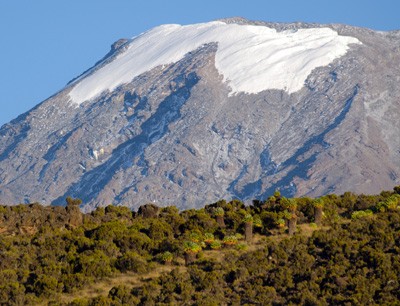
This is the view at the Kilimanjaro from southeast, tropic vegetation in the foreground. (Credit: Douglas Hardy)
A new study shows that land-cover changes, in particular deforestation, in the vicinity of glaciers do not have an impact on glacier loss. However, the study, in which Innsbruck climate researcher were directly involved, also shows that deforestation decreases precipitation in mid elevation zones, which affects the quality of life of the population living in the surrounding areas. The composition of land surface - such as vegetation type and land use - regulates the interaction of radiation, sensible heat and humidity between the land surface and the atmosphere and, thus, influences ground level climate directly. For the first time, the Innsbruck climate scientists quantitatively examined whether land-cover changes (LCC) may potentially affect glacier loss. "We used Kilimanjaro in East Africa as a test case, where a significant decrease of forests at elevations between 1,800 and 3,000 meters, caused by illegal deforestation and an increased number of forest fires, has been documented since the 1970s," explains climate researcher Thomas Mölg, who has worked in Berlin since 1 October 2011 but finished the study with his team at the University of Innsbruck. The glaciers in the Kilimanjaro area have been shrinking for many decades, and climate researchers from Innsbruck and America have conducted thorough glaciological and meteorological measurements for ten years -ideal prerequisites for carrying out a comprehensive study about a potential connection between forest loss and glacier shrinking.
TO READ THIS ARTICLE, CREATE YOUR ACCOUNT
And extend your reading, free of charge and with no commitment.