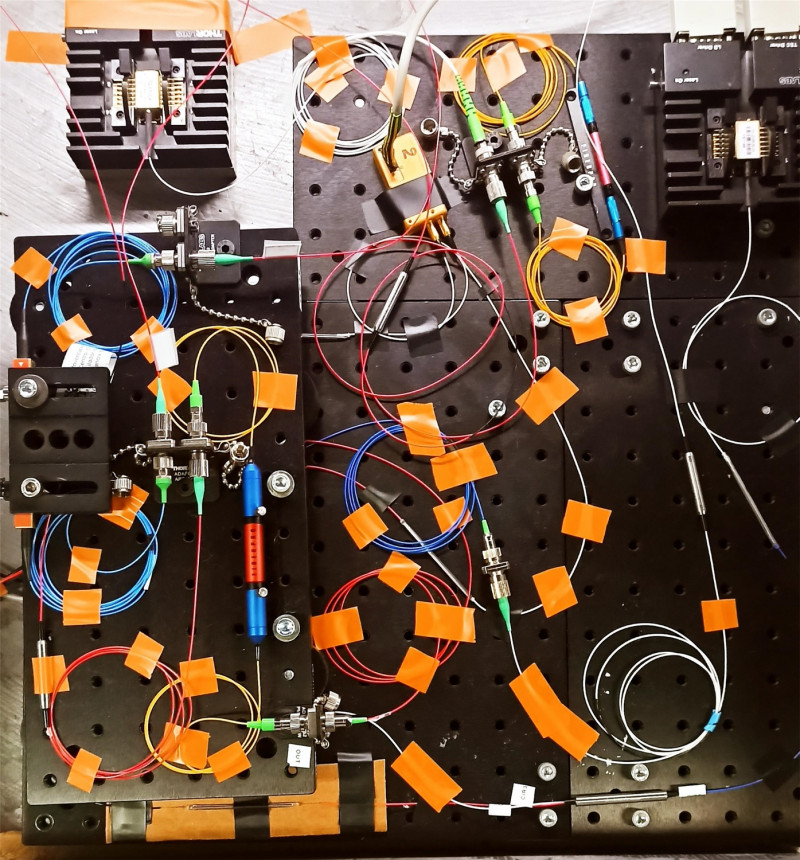
Experimental setup of the dendritic components of ADOPD consist of light conductors (rolled up), connectors (silver) and optical computing components (colored or black) Photo: Ingo Fischer und Apostolos Argyris, Agencia Estatal Consejo Superior de Investigaciones Cientificas, Mallorca
Experimental setup of the dendritic components of ADOPD consist of light conductors (rolled up), connectors (silver) and optical computing components (colored or black) Photo: Ingo Fischer und Apostolos Argyris, Agencia Estatal Consejo Superior de Investigaciones Cientificas, Mallorca University of Göttingen coordinates new European research project on ultra-fast, fibre-optic technology The University of Göttingen will lead the new European project "Adaptive Optical Dendrites (ADOPD)" for research into alternative, ultra-fast computer components based on neuronal signalling systems. The project, led by Professor Florentin Wörgötter and Dr Christian Tetzlaff from the Institute of Physics, focusses on how the functioning of neuronal cells can be transferred to fibre-optic-based computer components. The University of Göttingen will receive funding of around 750,000 euros over three years. Currently, fibre-optic technology is mainly used for fast data transmission. What is less well known is that fibre optics and other optical components can also be used for very high speed calculations. Another advantage of using fibre optics is their very low energy consumption: they consume less than a hundredth of the energy required by conventional computer components. To bring the different components together optimally, the ADOPD project uses structures based on the function of neurons.
TO READ THIS ARTICLE, CREATE YOUR ACCOUNT
And extend your reading, free of charge and with no commitment.