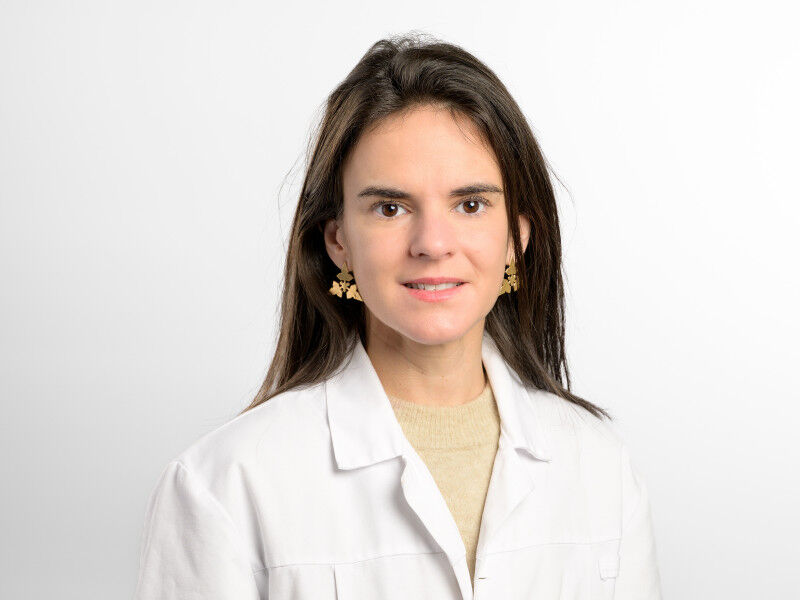
A specialist in resistant depression in the elderly, Beatriz Pozuelo Moyano discusses the challenges associated with this disorder and, in some cases, advocates interventional psychiatry approaches such as electroconvulsive therapy (ECT) neuromodulation. Interview with a clinician-researcher.
Beatriz Pozuelo Moyano’s career path began with a hesitation: for a long time, the young doctor oscillated between the fields of physical medicine, such as neurology or internal medicine, and psychiatry. And this hesitation almost became a "program": from her earliest research, carried out during her studies in Spain, she became interested in multiple sclerosis, already a frontier area, with inevitable overlaps, between the two disciplines.
After graduating in Madrid, Beatriz Pozuelo Moyano wanted to discover another medical culture: she arrived in Switzerland in 2013, first at the CHUV, then at the Centre neuchâtelois de psychiatrie and the HUG. If she ultimately chose psychiatry, it’s no coincidence that she is now in charge of Pyxis, the Organic Psychiatric Disorders Unit of the CHUV’s Service universitaire de psychiatrie de l’âge avancé (SUPAA). In psychogeriatrics, the doctor, who was appointed to the Privatdoctorate of the University of Lausanne in December 2025, has found a strong link between the two worlds of psychiatry and somatic medicine, which also enables her to maintain her taste for research.
Beatriz Pozuelo Moyano, depression is at the heart of your research. As a clinician and researcher, what is the first difficulty in tackling this pathology?
The first observation is that depression is often treated as a single illness, whereas its symptomatology is very heterogeneous. If we look at the DSM-5, the diagnostic and statistical manual that is the "Bible" for psychiatrists when it comes to defining disorders, we see that 200 combinations of symptoms are possible to arrive at this diagnosis. Behaviours differ, as do the development of the disease, response to treatment, etc. Not to mention that, in some cases, depression can be associated with physical pathology, dementia... As part of my doctorate in medicine, I set out to understand how different subtypes, according to the DSM-5 classification, evolve over time. These subtypes include the "melancholic" form, characterized by pervasive sadness, and the "atypical" form, in which great fatigue is combined with great lability and "mood swings". I’m being very schematic here, but the point is that these various subtypes have a relatively stable clinical presentation, which tends to indicate that we have good diagnostic validity.
What about resistant depression?
I looked into this question as part of my PhD, carried out partly in Lausanne and partly in London, at UCL and King’s College. I should add that I was awarded a grant from the Department of Psychiatry at CHUV, as well as a "Tremplin" subsidy from the University of Lausanne’s Equality Office, to do this work. In England, I worked with a cohort of patients in South London, studying the prevalence of this problem in the population. What emerged was a total lack of homogeneity in the definition of resistant depression. That’s why I set up a European task force of around thirty experts. We arrived at the following consensus: we talk of resistant depression after the therapeutic failure of two antidepressant treatments, with adequate dosage and duration, excluding acute physical pathologies (such as endocrine diseases, like hypothyroidism, or stroke) and dementia. I should add that we have created a register of these resistant pathologies at SUPAA.
What can be done about this resistant depression, particularly in the elderly?
For the elderly in particular, from the age of 65, we need to move towards more personalized medicine. Depression in the elderly is very often associated with an organic cause. For example, vascular depression, i.e. lesions in the brain’s white matter. On the other hand, in young people, depression is generally associated with a primary psychiatric etiology. I would add that depression in the elderly is often atypical, "masked" by other symptoms - fatigue, irritability, hostility - and therefore difficult to diagnose. And once it is detected, it is often more difficult to treat: since the etiology of depression is often non-psychiatric (but physical), it responds less well to psychotropic drugs.
In my clinic, I use interventional psychiatry approaches such as electroconvulsive neuromodulation (ECT), which aims to trigger an epileptic seizure, repetitive transcranial magnetic stimulation (rTMS), or ketamine. With ECT, remission rates often exceed 60%. We therefore need to identify - and this is where clinical and research intertwine - which variables are conducive to a good response to treatment.
Another problem identified is "pseudo-resistance": what is this?
Pseudo-resistance refers to cases where the patient does not respond to treatment, but the drug is not directly to blame. There are several possible scenarios. Firstly, an incorrect diagnosis: for example, the doctor may have overlooked hypothyroidism, or diagnosed unipolar depression when in fact the patient is bipolar. Secondly, a pharmacological cause: there is no adherence to treatment. In other words, the medication can’t take effect, because the patient isn’t taking it properly. We know that nearly 60% of patients do not take their medication! The last case refers to more fundamental causes, linked to metabolism, pharmacokinetics, pharmacodynamics and the crossing of the blood-brain barrier. To untangle the mystery, we are working with the CHUV’s clinical psychopharmacology unit: the idea is to find out what percentage of elderly patients have the correct therapeutic rate, in other words, whether the dosage of the drug in the blood is adequate. This should enable us to isolate "true" resistants from pseudo-resistants. We can’t put a figure on it yet, but we do know that the problem of pseudo-resistance is very significant in the elderly. In the same vein, we are collaborating with the CHUV’s Centre for Psychiatric Neurosciences on the identification of biomarkers enabling us to assess the response to certain treatments.
You are also working on the link between depression and dementia...
Yes, we are. We know that depression in adults is a risk factor for dementia in old age. But which subtypes are potentially more likely to cause dementia - that’s one of the questions we’re asking.
Alongside your research, you are also very active in the Interventional Psychiatry Unit, which treats all types of patients.
Yes, because it’s a cross-disciplinary unit, we also treat adults and even adolescents in certain situations. But I wouldn’t pit interventional psychiatry (which is the responsibility of Dr. Kevin Swierkosz-Lenart, who is also a clinician-researcher in the department) against clinical research. On the contrary, in this context, the link is very strong, with the clinic generating a huge number of research questions: why do patients suffering from a certain form of so-called melancholic depression seem to respond better to ECT - What is the optimal duration of an ECT-induced epileptic seizure - This is a little-explored question: at most, the American guidelines suggest a minimum duration of 20 seconds and a maximum duration of two minutes. This is vague, but the issue is crucial: the longer the duration, the greater the side effects, such as confusion, in the elderly. Our data, still very exploratory, suggest that the most favorable response is between 40 and 50 seconds of seizure. In a rather pioneering approach, we also use ECT to treat elderly people suffering from psychobehavioral symptoms of dementia - BPSD in our jargon. These disorders, which are characterized by refusal to eat, vocalization, wandering, agitation and even strong aggression, often lead to hospitalization. Yet we have had very favorable responses with ECT, even in very severe cases. This means shorter hospital stays.
What happens at a fundamental level when a patient is subjected to ECT?
We still lack data, but ECT seems to have a positive impact by modulating brain circuits disrupted in mood disorders, promoting brain plasticity (and possibly neurogenesis) and influencing certain neurotransmitters involved in depression.
Does ECT, which the public may equate with electroshock therapy often grimly portrayed in the cinema, suffer from an image deficit?
I’d like to make it clear from the outset that treatment today is carried out under anaesthetic. ECT can be highly effective, particularly in the elderly, in catatonia and in certain severe forms of bipolar disorder or depression, especially when the person no longer eats, drinks or remains immobile.