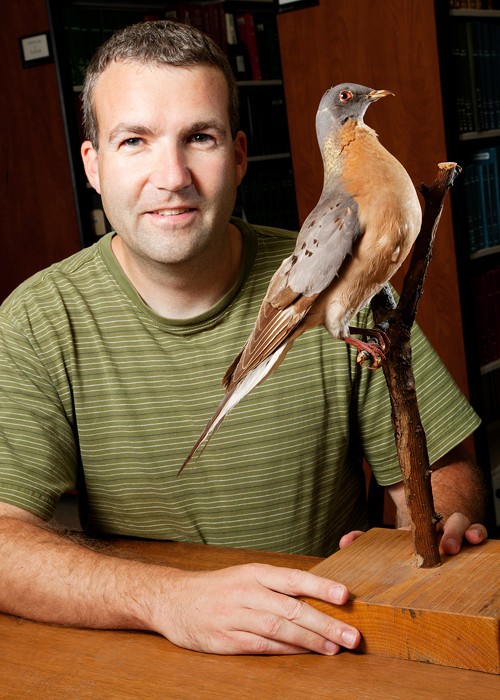
Kevin Johnson, an ornithologist with the Illinois Natural History Survey at the University of Illinois, led a genetic study that placed the extinct passenger pigeon in the family tree of pigeons and doves.
CHAMPAIGN, lll. With bits of DNA extracted from century-old museum specimens, researchers have found a place for the extinct passenger pigeon in the family tree of pigeons and doves, identifying for the first time this unique bird's closest living avian relatives. The new analysis, which appears this month in Molecular Phylogenetics and Evolution, reveals that the passenger pigeon was most closely related to other North and South American pigeons, and not to the mourning dove, as was once suspected. Naturalists have long lamented that one of North America's most spectacular birds was also one of the first to be driven to extinction. In the early 1800s it was the most abundant bird species on the planet, even though its range was limited to the eastern and central forests of the United States and parts of eastern Canada. Flocks of passenger pigeons were so vast they darkened the sky; it could take days for a flock to pass overhead. "It must have been unbelievable to see one of these flocks," said Kevin Johnson , an ornithologist with the Illinois Natural History Survey at the University of Illinois and lead author of the study.
TO READ THIS ARTICLE, CREATE YOUR ACCOUNT
And extend your reading, free of charge and with no commitment.