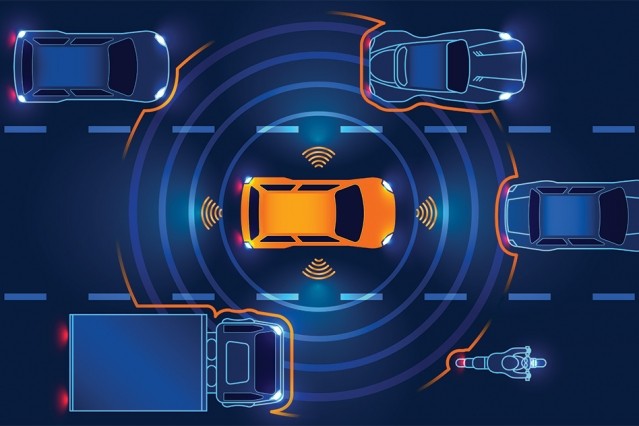
At the International Conference on Robotics and Automation tomorrow, researchers from MIT’s Computer Science and Artificial Intelligence Laboratory (CSAIL) will present a new lane-change algorithm.
In the field of self-driving cars, algorithms for controlling lane changes are an important topic of study. But most existing lane-change algorithms have one of two drawbacks: Either they rely on detailed statistical models of the driving environment, which are difficult to assemble and too complex to analyze on the fly; or they're so simple that they can lead to impractically conservative decisions, such as never changing lanes at all. At the International Conference on Robotics and Automation tomorrow, researchers from MIT's Computer Science and Artificial Intelligence Laboratory (CSAIL) will present a new lane-change algorithm that splits the difference. It allows for more aggressive lane changes than the simple models do but relies only on immediate information about other vehicles' directions and velocities to make decisions. "The motivation is, 'What can we do with as little information as possible?'" says Alyssa Pierson, a postdoc at CSAIL and first author on the new paper. "How can we have an autonomous vehicle behave as a human driver might behave? What is the minimum amount of information the car needs to elicit that human-like behavior?" Pierson is joined on the paper by Daniela Rus, the Viterbi Professor of Electrical Engineering and Computer Science; Sertac Karaman, associate professor of aeronautics and astronautics; and Wilko Schwarting, a graduate student in electrical engineering and computer science. "The optimization solution will ensure navigation with lane changes that can model an entire range of driving styles, from conservative to aggressive, with safety guarantees," says Rus, who is the director of CSAIL.
TO READ THIS ARTICLE, CREATE YOUR ACCOUNT
And extend your reading, free of charge and with no commitment.