Seven exciting projects created using Marvin have now faced off against one another in a contest won by a group that has laid the foundations for a form of ChatGPT in Portuguese.
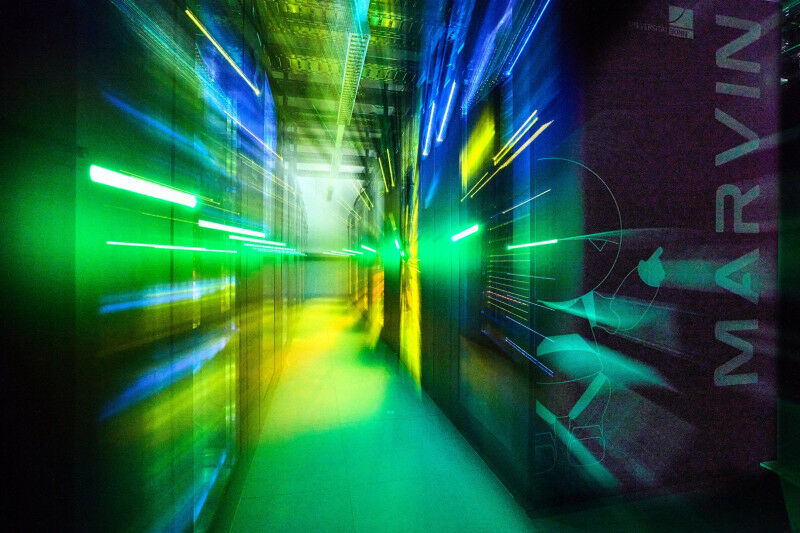
"Marvin isn’t just a computer," explained Professor Maren Bennewitz, Vice Rector for Digitalization and Information Management. "It’s a real game-changer for the University of Bonn and has opened the door to some entirely new scientific possibilities." She stressed the important role that the supercomputer is playing in the University’s strategies for excellence and digitalization: "We’ve invested substantial amounts in building state-of-the-art HPC infrastructure for research as part of our Excellence and Digital Strategies. This has been made possible in particular by the structures that we’ve recently put in place in the Digital Science Center, or DiCe."
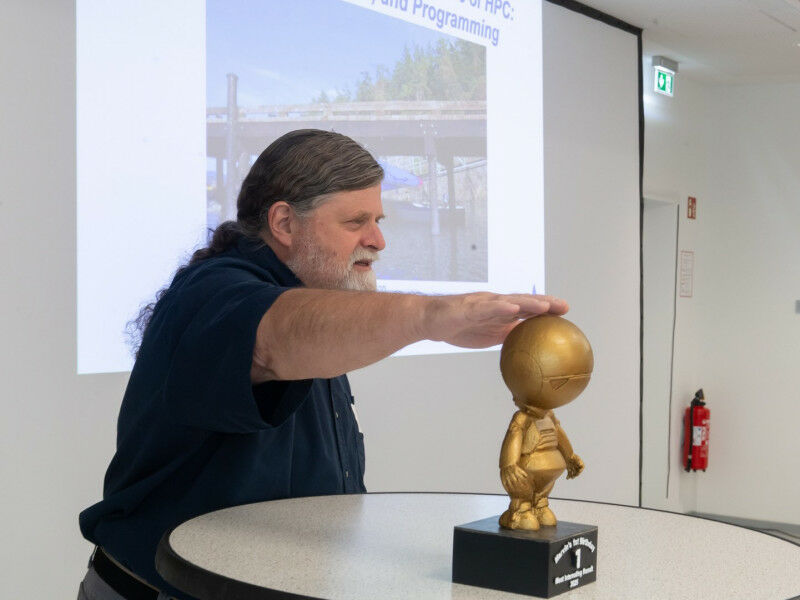
A trophy for the most exciting Marvin project
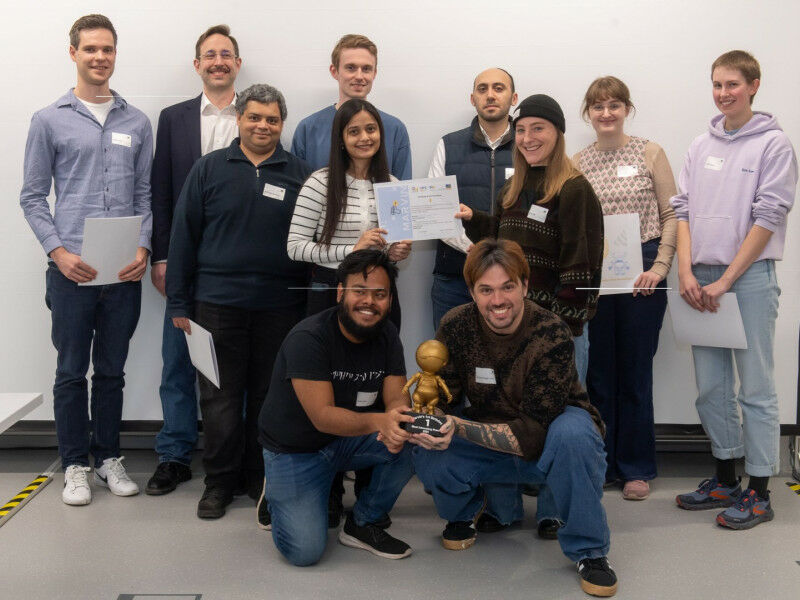
Seven finalists representing a range of disciplines-from theoretical chemistry and geodesy through to linguistics, biology and astrophysics-presented their exceptional projects, which came to fruition with the help of calculations run on Marvin. The 100 or so guests then used a smartphone app to vote for their favorite. Ultimately, the winners’ trophy was claimed by the interdisciplinary team made up of Nicolas Kluge Corrêa (philosophy), Aniket Sen (physics), Shiza Fatimah (computer science) and Sophia Falk (environmental sciences) for their project entitled "Tucano: Advancing Neural Text Generation for Portuguese." As well as "extra computing capacity," the first prize also includes close project support from a member of the HPC support team, whose assistance-from code testing to software installation and specific training-is just what the group of researchers needs.
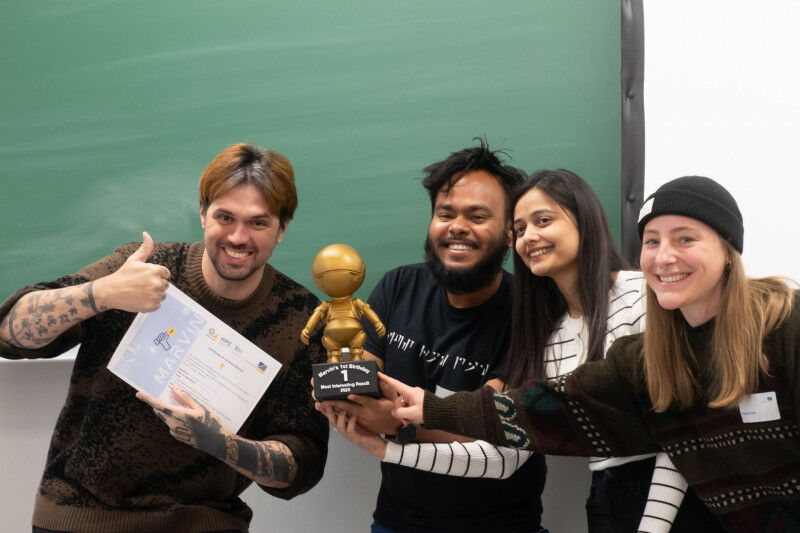
"We couldn’t be happier!" Nicolas Kluge Corrêa exclaimed. "Our project is about developing models like ChatGPT for languages for which there’s less data available than for English, say." He and his team started by laying the groundwork for Portuguese, because he himself comes from Brazil and speaks the language. But the team has a lot more in the pipeline: "Next up, we’re planning to do the same kind of research for some of our other languages. Aniket speaks Bengali and Shiza Hindi." He stressed that none of this would be possible without Marvin "and the fantastic support we’ve had from the University of Bonn." Second place went to Katrin Drysch for her project "Development of magnesium batteries," with Mohamad Hakam Shams Eddin and Jürgen Gall coming third with "Identifying Spatio-Temporal Drivers of Extreme Events."
A wide range of services for researchers, from technical support to consulting
Making Marvin available to researchers is not just about cutting-edge technology, Vice Rector Bennewitz pointed out, but also about providing an easily accessible service. "Right from the start, we also wanted to build central HPC infrastructure with corresponding support structures. Under your leadership, Dirk Barbi, the HPC team in University IT has grown into a vital unit for operation and training. And together with you, Petra Mutzel, we’ve succeeded in establishing the High Performance Computing and Analytics Lab at the DiCe as a key hub for advising our researchers."
A year full of groundbreaking research findings
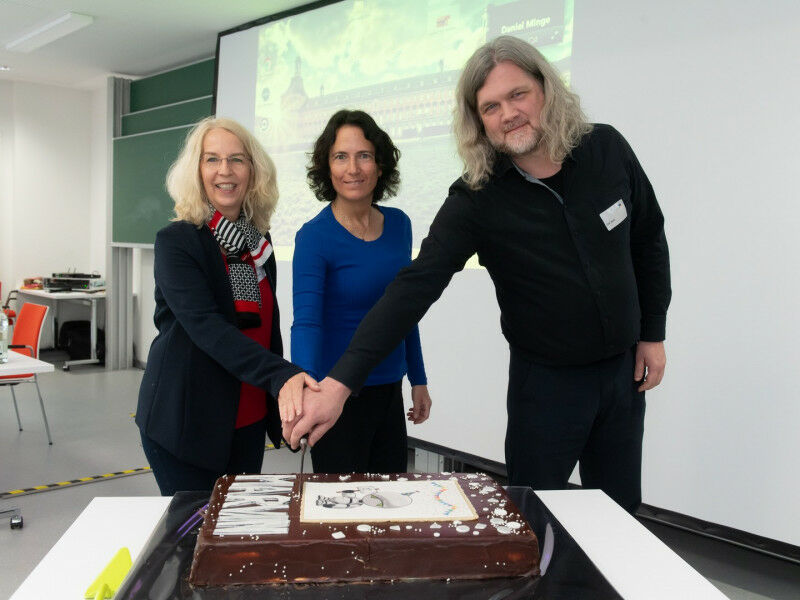
Professor Petra Mutzel and Dirk Barbi, ably supported at the event by Daniel Minge from the Modelling Transdisciplinary Research Area, took the opportunity to look back over the past 12 months. "Marvin has given our researchers a toolkit for all kinds of different disciplines, from revolutionary simulations in theoretical chemistry to pioneering applications of AI for analyzing historical manuscripts," explained Professor Mutzel. She and her team are responsible for advising researchers on using Marvin. Dr. Barbi, who is in charge of the technology together with his team, added: "In Marvin, we’ve created a stable piece of central infrastructure that unlocks research at the very highest level. We’re well equipped, including when it comes to artificial intelligence."
A glimpse into the future world of supercomputing
Marvin the supercomputer: facts, figures and dates
With a connected load of 430 kW, 14 racks, 320 NVIDIA GPUs and 18,400 CPU cores, Marvin is among the most powerful academic supercomputers in Germany. Two thirds of its capacity has been specifically optimized for machine learning and AI applications, something of which no other university supercomputer can boast. Marvin has already helped 495 registered users from 102 research groups since it began operating on March 11, 2024, during which time 1,022 support requests have been processed and a total of 46 courses supported. While the HPC team from University IT is responsible for Marvin’s technical operation and support, their colleagues in the HPC/A Lab serve as the primary contacts and coordinators for the researchers.
The University of Bonn’s Digital Strategy sets out the measures and structures required for its digital transformation. The Marvin project formed part of the Infrastructure for Research, Teaching and Services set of objectives.
Dr. Dirk Barbi (HPC/University IT) for technical inquiries:
228 73-66136