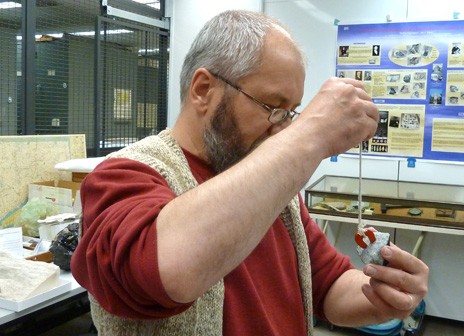
Mineralogist Stefan Nicolescu demonstrating the meteorite’s magnetic field. (Photo by Melanie Brigockas)
An object that fell through the roof of a house in Wolcott on April 19 was confirmed to be a meteorite by Stefan Nicolescu, mineralogy collections manager at the Yale Peabody Museum of Natural History. The meteorite split into two pieces as it hit the roof and fell through the ceiling onto the attic floor. The smaller part, which was brought to the Peabody for identification, weighed 7.8 ounces and is 2.5 x 2 x 1.5 inches in size. Nicolescu described the meteorite as an ordinary chondrite, the most common type of meteorite. It has an intense black, very thin fusion crust from heat generated when the rock came through the atmosphere, and a light gray interior. Small blobs - called chondrites - are visible on the fresh inside (where it broke from the other piece found). It has enough metallic iron interspersed in its mass to attract a magnet.
TO READ THIS ARTICLE, CREATE YOUR ACCOUNT
And extend your reading, free of charge and with no commitment.