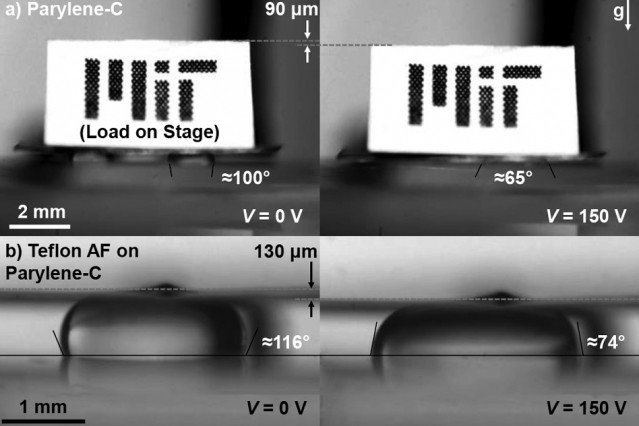
New MIT research could offer a way of making tiny movable parts with no solid connections between the pieces, potentially eliminating a major source of wear and failure in microelectromechanical machines. The new system uses a layer of liquid droplets to support a tiny, movable platform.
Microelectromechanical systems, or MEMS, are tiny machines fabricated using equipment and processes developed for the production of electronic chips and devices. They've found a wide variety of applications in today's consumer electronics, but their moving parts can wear out over time as a result of friction. A new approach developed by researchers at MIT could offer a new way of making movable parts with no solid connections between the pieces, potentially eliminating a major source of wear and failure. The new system uses a layer of liquid droplets to support a tiny, movable platform, which essentially floats on top of the droplets. The droplets can be water or some other fluid, and the precise movements of the platform can be controlled electrically, through a system that can alter the dimensions of the droplets to raise, lower, and tilt the platform. The new findings are reported in a paper in Applied Physics Letters , co-authored by Daniel Preston, an MIT graduate student; Evelyn Wang, the Gail E. Kendall Associate Professor of Mechanical Engineering; and five others. A new approach to microelectromechanical systems (MEMS), developed by a team of researchers at MIT, could offer a new way of making movable parts with no solid connections between the pieces, potentially eliminating a major source of wear and failure.
TO READ THIS ARTICLE, CREATE YOUR ACCOUNT
And extend your reading, free of charge and with no commitment.