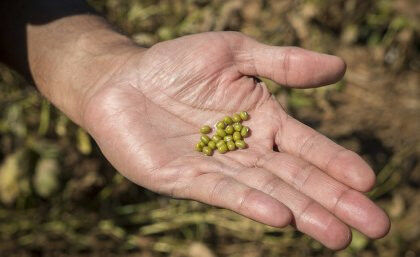
Mungbean grown in Kingaroy, Queensland.
Mungbean grown in Kingaroy, Queensland. From ancient, 'gassy' legume to low-carbon, nutritional powerhouse, mungbeans are being given a global makeover, led by researchers at The University of Queensland. Newly-appointed Professor in Legume Genomics, Michael Udvardi , said the research team was analysing genetics in mungbeans which could eventually lead to developing more climate-resilient crops. "Mungbean is an up-and-comer in the world of high-protein food products, and is mostly exported to India and southeast Asia," Professor Udvardi said. "The increased interest calls for a deeper understanding of seed metabolism and its underlying genetics." Professor Udvardi's research team is characterising a ll genes and genetic variation of mungbean - its pan-genome - to identify naturally occurring variation in individual varieties and the species. "The more information we have on the full genetic potential of mungbeans, the better placed we are to develop the next generation of nutrient-efficient, climate-resilient legume crops for Australia," he said. "In order to do so, we're working closely with plant physiologists, agronomists, modelers and breeders." He said mungbeans and other legumes are self-fertilising for nitrogen, an important characteristic.
TO READ THIS ARTICLE, CREATE YOUR ACCOUNT
And extend your reading, free of charge and with no commitment.