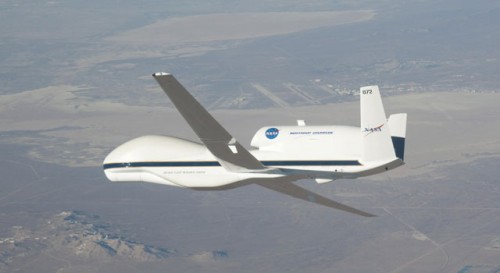
The Global Hawk can fly autonomously to altitudes above 60,000 feet -- roughly twice as high as a commercial airliner -- and as far as 11,000 nautical miles. Operators pre-program a flight path, and then the plane flies itself for as long as 30 hours. Credit: NASA/Dryden/Carla Thomas
PASADENA, Calif. NASA has successfully completed the first science flight of the Global Hawk unpiloted aircraft system over the Pacific Ocean. The flight was the first of five scheduled for this month's Global Hawk Pacific, or GloPac, mission to study atmospheric science over the Pacific and Arctic oceans. The Global Hawk is a robotic plane that can fly autonomously to altitudes above 18,288 meters (60,000 feet) - roughly twice as high as a commercial airliner - and as far as 20,372 kilometers (11,000 nautical miles), which is half the circumference of Earth. Operators pre-program a flight path, then the plane flies itself for as long as 30 hours, staying in contact through satellite and line-of-site communications links to a ground control station at NASA's Dryden Flight Research Center in California's Mojave Desert. "The Global Hawk is a revolutionary aircraft for science because of its enormous range and endurance," said Paul Newman, co-mission scientist for GloPac and an atmospheric scientist from NASA's Goddard Space Flight Center in Greenbelt, Md. "No other science platform provides the range and time to sample rapidly evolving atmospheric phenomena.
TO READ THIS ARTICLE, CREATE YOUR ACCOUNT
And extend your reading, free of charge and with no commitment.