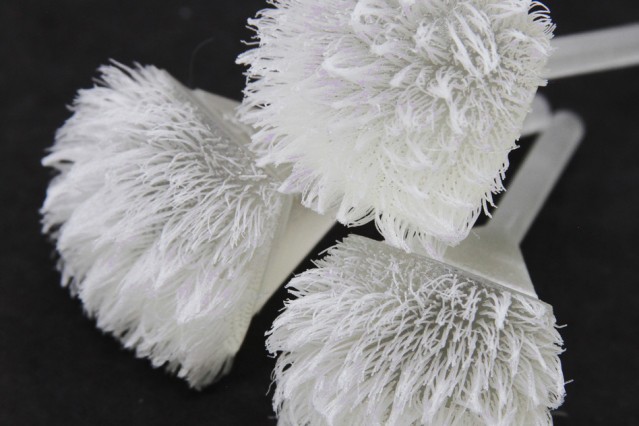
"It’s very inspiring to see how these [hair-like] structures occur in nature and how they can achieve different functions," says Jifei Ou, a graduate student in media arts and sciences at MIT. "We’re just trying to think how can we fully utilize the potential of 3-D printing, and create new functional materials whose properties are easily tunable and controllable." Pictured is an example of 3-D printed hair.
These days, it may seem as if 3-D printers can spit out just about anything, from a full-sized sports car, to edible food, to human skin. But some things have defied the technology, including hair, fur, and other dense arrays of extremely fine features, which require a huge amount of computational time and power to first design, then print. Now researchers in MIT's Media Lab have found a way to bypass a major design step in 3-D printing, to quickly and efficiently model and print thousands of hair-like structures. Instead of using conventional computer-aided design (CAD) software to draw thousands of individual hairs on a computer - a step that would take hours to compute - the team built a new software platform, called "Cilllia," that lets users define the angle, thickness, density, and height of thousands of hairs, in just a few minutes. Using the new software, the researchers designed arrays of hair-like structures with a resolution of 50 microns - about the width of a human hair. Playing with various dimensions, they designed and then printed arrays ranging from coarse bristles to fine fur, onto flat and also curved surfaces, using a conventional 3-D printer. They presented a paper detailing the results at the Association for Computing Machinery's CHI Conference on Human Factors in Computing Systems in May.
TO READ THIS ARTICLE, CREATE YOUR ACCOUNT
And extend your reading, free of charge and with no commitment.