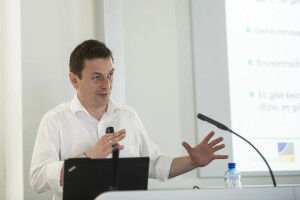
Prof. Koldehofe, if you had to explain why this topic is so relevant to someone who has only ever heard of "Wi-Fi" and "cell phone networks", how would you do it?
More and more of our everyday devices are networked and every interaction with today’s IT systems requires communication between a large number of computer systems - from cash withdrawals to "smart" lawnmowers. Communication systems have therefore become a central part of our critical infrastructure and have a significant influence on the functionality of technical services in almost all’areas of life. On the one hand, aspects such as reliability, availability, and security play an important role. On the other hand, modern IT systems also require high performance and adaptability, as both users and computer systems use a wide range of different technologies.NetSys 2025, organized by the specialist group "Communication and Distributed Systems" in the German Informatics Society and the Information Technology Society in the Association for Electrical, Electronic & Information Technologies, will bring more than 100 experts from all’over the world to Ilmenau. Which major issues and challenges in the field of networked systems are currently in the foreground? By way of example, I would like to mention two central issues that are also listed as key in the so-called "Grand Challenges" of the German Informatics Society for future IT systems. On the one hand, it is about new networking concepts that can cope resiliently and efficiently with the increasing merging of the virtual world with the physical world.
In order to enable central areas of application such as Industry 4.0, smart cities, smart grids, virtual reality, connected driving and telemedicine, more and more components are being networked to form an "Internet of Everything". This development places high demands on the transmission efficiency and security of the communicating systems. It is crucial to reliably support these services even if parts of the infrastructure are no longer available, for example as a result of a cyber attack, or if disasters lead to an infrastructure failure.
Another important aspect is the support of so-called decentralized AI systems. This means that not all’information is brought together centrally in cloud data centers of large providers, but is processed and made available as locally as possible - i.e. directly at the user’s location. In the context of "edge computing", this involves processes that enable decentralized and local processing on computing resources close to the user. In addition to greater transmission efficiency, this approach can also bring significant advantages for the privacy of the processed data.
In his opening keynote at NetSys, Walter Willinger, Chief Scientist at NIKSUN, Inc, a cyber security company based in Princeton, USA, will make the following statement: "If something looks too good to be true, it usually is."
I am particularly looking forward to this presentation. It is primarily about understanding how we are increasingly relying on AI in the design and development of communication systems.
A large number of developments and innovations are aimed at using the potential of artificial intelligence to optimize networked systems more easily. However, the naïve use of AI certainly harbors risks and problems with regard to reliable and robust communication.
I therefore expect a critical perspective here that highlights the problems but also the opportunities for AI in the development of future networked systems.
Many people associate networks primarily with convenience - fast internet, video conferencing, streaming. Where exactly are the risks if networks are not secure, stable, or trustworthy?
Well, since many systems now not only transmit information but also control and monitor physical systems, as in the case of autonomous driving, unstable and insecure systems are a huge risk for our society.
In addition to secure and reliable data transmission and processing, the further development of our networks and networked systems is therefore increasingly also about protecting lives and material assets. Unfortunately, there is still a great need for action and research in this area.
You yourself are also concerned with the energy efficiency of such systems.
Especially in the age of AI, the demands on computing power have increased enormously. On the other hand, it is becoming increasingly difficult to increase the efficiency of traditional computing systems, especially given the limited amount of natural resources available to us. As part of the Ilmenau School of Green Electronics, we are therefore also looking at innovative developments for completely new alternative computer architectures that achieve higher energy efficiency - for example, by enabling communication lines not only to transmit data, but also to pre-process it directly.NetSys is a meeting place for research, industry and administration. What role does this exchange play when it comes to not only researching such technologies, but also actually bringing them into society?
NetSys is about exchanging ideas on relevant issues and problems as well as getting to know each other and networking. Some members of this community are involved in the national and international standardization of processes and protocols, for example. Other visitors work in industry, for example in telecommunications companies, directly on the development of products. Others work on administrative problems and social challenges in public organizations and authorities. The direct exchange will certainly result in networks that promote new innovation in the field of networked systems.What would you like visitors - whether experts or laypeople - to take away from Ilmenau after four days of NetSys?
Our aim is to provide participants with a representative overview of current issues relating to networked systems and which research institutions are working on which problems. Of course, the involvement and promotion of young scientists also plays a key role here. Furthermore, I hope that many participants will perceive the TU Ilmenau as an important location for science and research, which is strongly positioned in this area.Boris Koldehofe has headed the Distributed and Operating Systems Group at TU Ilmenau since February 2023. After studying computer science at Saarland University, he was initially drawn to the international research world: he completed his doctorate at Chalmers Tekniska Högskola in Sweden, habilitated at TU Darmstadt and worked at renowned institutions such as the École polytechnique fédérale de Lausanne (EPFL) in Switzerland, the Universities of Stuttgart and Heidelberg and most recently as a full professor at the University of Groningen.
His research is always at the interface between theory and application. Current projects on in-network computing and the integration of programmable communication systems with memristor-based memory and computer architectures focus on the question of how distributed systems can be made more powerful, secure and efficient. The aim is to make data analysis not only faster, but also significantly more energy-efficient - an approach that is becoming increasingly important in view of the growing demands of artificial intelligence and networked systems.