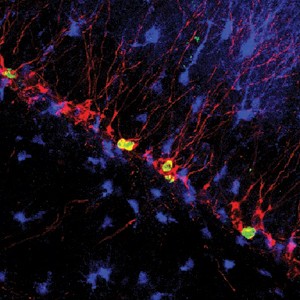
The figure shows newly born nerve cells (green) colocalizing with a neuronal marker which indicates immature nerve cells (red). Astrocytes are labelled in blue.
Fear burns memories into our brain, and new research by University of California, Berkeley, neuroscientists explains how. Scientists have long known that fear and other highly emotional experiences lead to incredibly strong memories. In a study appearing online today (Tuesday, June 14) in advance of publication in the journal Molecular Psychiatry , UC Berkeley's Daniela Kaufer and colleagues report a new way for emotions to affect memory: The brain's emotional center, the amygdala, induces the hippocampus, a relay hub for memory, to generate new neurons. In a fearful situation, these newborn neurons get activated by the amygdala and may provide a 'blank slate? on which the new fearful memory can be strongly imprinted, she said. In evolutionary terms, it means new neurons are likely helping you to remember the lion that nearly killed you. 'We remember emotional events much more strongly than daily experiences, and for a long time we have known that connections between the amygdala and hippocampus help to encode this emotional information,' said Kaufer, an assistant professor of integrative biology and a member of UC Berkeley's Wills Neuroscience Institute. 'Our research shows that amygdala input actually pushes the hippocampus to make new neurons from a unique population of neural stem cells.
TO READ THIS ARTICLE, CREATE YOUR ACCOUNT
And extend your reading, free of charge and with no commitment.