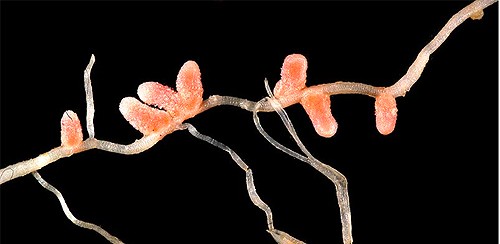
Nodules on the roots of legume plants contain rhizobia, the bacteria that can ’fix’ nitrogen in the air to make it usable to living things.
David Pulsford, an alumnus of the Faculty of Agriculture and Environment , and an industry leader in nitrogen fixation, will be honoured with a special award from the faculty and the opening of a new lab bearing his name. Professor Mark Adams , Dean of the Faculty of Agriculture and Environment , will present the award to David on 25 June at the first day of the 16th Australian Nitrogen Fixation Conference , to be held at Q Station Manly. David has played an important role in nitrogen fixation since the late 1950s and generously supported the SUNFix Centre for Nitrogen Fixation at the University of Sydney, which closed in December 2011, but whose research will continue in the new Pulsford Laboratory. "It is befitting that David Pulsford's name will be entered in the faculty's 'hall of fame' by naming a lab after him, as it allows us to publicly acknowledge the impact he's had in nitrogen fixation in Australia and his long association with the University from the commercial sector," said Emeritus Professor Ivan Kennedy , from the Faculty of Agriculture and Environment, and organiser of the 16th Australian Nitrogen Fixation Conference. Graduating with a Bachelor of Science in Agriculture from the University of Sydney, David worked with nitrogen fixing microbial products in his role at Agricultural Laboratories and later in his own company Bio-Care Technology. "Biological nitrogen fixation is one of the most important biological processes on earth. It allows plants to grow in soils that have low nitrogen, by 'fixing' nitrogen from the air into a form that living things can use.
TO READ THIS ARTICLE, CREATE YOUR ACCOUNT
And extend your reading, free of charge and with no commitment.