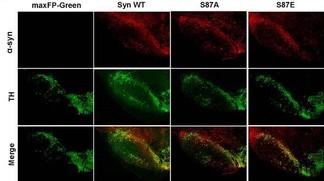
Mimicking Phosphorylation at Serine 87 Inhibits the Aggregation of Human α-Synuclein and Protects against Its Toxicity in a Rat Model of Parkinson's Disease. Several lines of evidence suggest that phosphorylation of α-synuclein (α-syn) at S87 or S129 may play an important role in regulating its aggregation, fibrillogenesis, Lewy body formation, and neurotoxicity in vivo. However, whether phosphorylation at these residues enhances or protects against α-syn toxicity in vivo remains unknown. In this study, The groups of Hilal Lashuel (LMNN - Laboratory of Molecular Neurobiology and Neuroproteomics ) and Patrick Aebischer (LEN - Neurodegenerative Studies Laboratory ) investigated the cellular and behavioral effect of overexpression of wild-type (WT), S87A, and S87E α-syn to block or to mimic S87 phosphorylation, respectively, in the substantia nigra of Wistar rats using recombinant adeno-associated vectors. They demonstrate, for the first time, that mimicking phosphorylation at S87 inhibits α-syn aggregation and protects against α-syn-induced toxicity in vivo, suggesting that phosphorylation at this residue would play an important role in controlling α-syn neuropathology. In addition, their results provide strong evidence for a direct correlation between α-syn-induced neurotoxicity, fiber pathology, and motor impairment and the extent of α-syn aggregation in vivo, suggesting that lowering α-syn levels and/or blocking its aggregation are viable therapeutic strategies for the treatment of Parkinson's disease and related synucleinopathies.
TO READ THIS ARTICLE, CREATE YOUR ACCOUNT
And extend your reading, free of charge and with no commitment.
Your Benefits
- Access to all content
- Receive newsmails for news and jobs
- Post ads