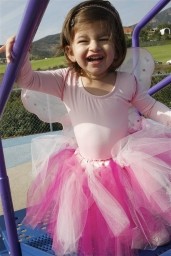
Anya, 2, who underwent non-invasive testing and surgery at UCLA, is now seizure-free.
When medication fails to control seizures in children with tuberous sclerosis complex (TSC), a rare genetic disorder that affects multiple organ systems and frequently causes epilepsy, surgery to remove part of the brain is often necessary. But pre-surgical testing, which involves the implanting of electrodes into a child's head, can lead to longer hospital stays and greater risks from surgery. Now, a study by researchers with UCLA's Pediatric Epilepsy Surgery Program has found that an alternative, non-invasive approach to pre-surgical testing, along with earlier consideration for surgery, is associated with the best seizure-free surgical outcome in patients with TSC. "Surgery to remove the portion of the brain causing the epilepsy is the most successful treatment for children with TSC and intractable epilepsy, but mapping which parts to take out can be challenging in a disease with multiple tubers in the brain and therefore multiple potential seizure-generating regions," said lead study author Dr. Joyce Wu, an associate professor of pediatric neurology at Mattel Children's Hospital at UCLA. "The standard test of implanting electrodes into the patient's head is uncomfortable, leads to a prolonged hospital stay with increased costs, and potentially increases the risks from surgery," she said. "Our study looked at the effectiveness of our non-invasive, diagnostic imaging approach, which appeared to work just as well." The study is the first to examine UCLA's non-invasive approach, which uses a combination of magnetic resonance imaging (MRI), fluoro-deoxyglucose positron emission tomography (FDG-PET) and magnetic source imaging (MSI) to identify the area of brain to be removed.
TO READ THIS ARTICLE, CREATE YOUR ACCOUNT
And extend your reading, free of charge and with no commitment.