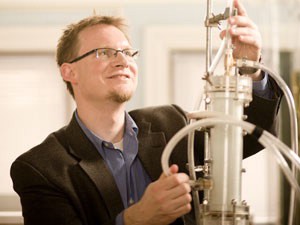
Martin Saar, an Earth sciences faculty member, and graduate student Jimmy Randolph have devised an ingenious "two-for-one" strategy to simultaneously produce renewable energy and reduce the presence of harmful carbon dioxide in the atmosphere.
Researchers have applied for a patent and plan to form a start-up company to commercialize the new technology. MINNEAPOLIS / ST. PAUL (06/03/2011) —Two University of Minnesota Department of Earth Sciences researchers have developed an innovative approach to tapping heat beneath the Earth's surface. The method is expected to not only produce renewable electricity far more efficiently than conventional geothermal systems, but also help reduce atmospheric carbon dioxide (CO2) - dealing a one-two punch against climate change. The approach, termed CO2-plume geothermal system, or CPG, was developed by Earth sciences faculty member Martin Saar and graduate student Jimmy Randolph in the university's College of Science and Engineering. The research was published in the most recent issue of Geophysical Research Letters. The researchers have applied for a patent and plan to form a start-up company to commercialize the new technology. Established methods for transforming Earth's heat into electricity involve extracting hot water from rock formations several hundred feet from the Earth's surface at the few natural hot spots around the world, then using the hot water to turn power-producing turbines.
TO READ THIS ARTICLE, CREATE YOUR ACCOUNT
And extend your reading, free of charge and with no commitment.