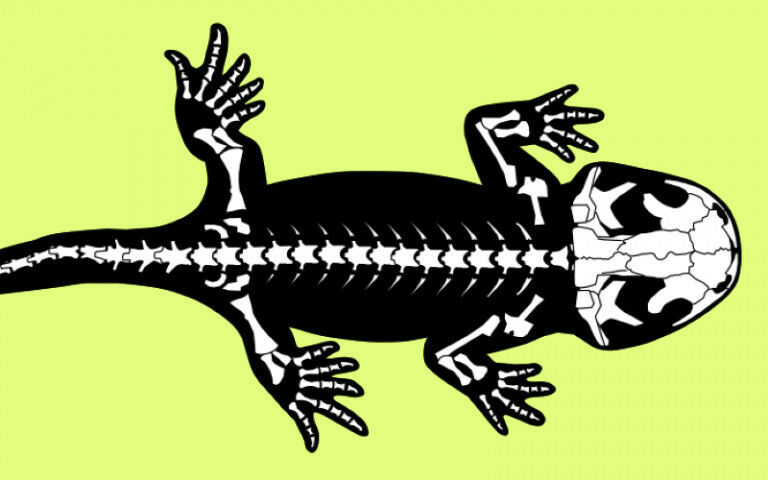
A drawing of Marmorerpeton wakei
A drawing of Marmorerpeton wakei Writing in The Conversation, Dr Marc Jones and Professor Susan Evans (UCL Cell & Developmental Biology) and Professor Richard Benson (University of Oxford) write about their research into a newly-identified extinct salamander species found in Scotland. In the fairy-tale landscape of the Isle of Skye off the north-west coast of Scotland, the skull of one of the most ancient salamanders ever discovered to date was excavated from Jurassic limestones. But it would be decades until scientists had the technology and the funding to piece the salamander together. Part of the skeleton was collected in the early 1970s when palaeontologists Michael Waldman and Robert Savage noticed black bone exposed on the hard grey rock surface, hinting at a fossil locked inside. They collected it realising that it could be something important. Although parts of the fossil were subsequently exposed, it was too little to warrant a detailed study. Therefore, the fossil remained in the rock and unstudied for another 45 years.
TO READ THIS ARTICLE, CREATE YOUR ACCOUNT
And extend your reading, free of charge and with no commitment.