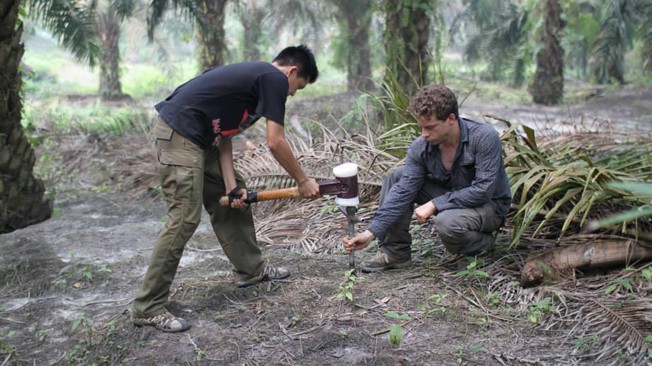
 Thomas Guillaume (on the right) collecting samples in Sumatra, Indonesia.
Palm oil has become part of our daily lives, but a recent study by EPFL and the Swiss Federal Institute for Forest, Snow and Landscape Research (WSL) serves as a reminder that intensive farming of this crop has a major impact on the environment. Both shortand long-term solutions exist, however. Indonesia and Malaysia together account for nearly 85% of global palm oil production. This oil is commonly used in processed foods, cosmetics and biofuels, and while it is inexpensive, the environmental and social costs are high. Each year, thousands of hectares of rainforest disappear in order to meet the growing demand for the oil worldwide. In 2012, Indonesia had the highest deforestation rate in the world, according to a study published in 2014 . Thomas Guillaume, a postdoctoral researcher at EPFL's Ecological Systems Laboratory (ECOS) and the Swiss Federal Institute for Forest, Snow and Landscape Research (WSL), is the lead author of a synthesis study on the environmental impact of oil palm cultivation in Indonesia.
TO READ THIS ARTICLE, CREATE YOUR ACCOUNT
And extend your reading, free of charge and with no commitment.
Your Benefits
- Access to all content
- Receive newsmails for news and jobs
- Post ads