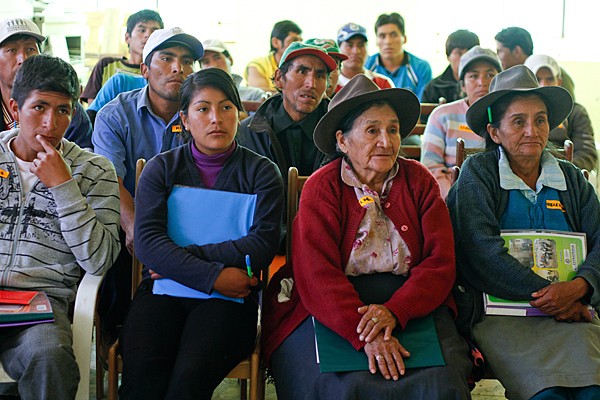
Villagers of Chocos during a training that focused on identifying vulnerabilities of adobe buildings and how to strengthen such buildings to be safe during earthquakes.
Children playing with wooden blocks that were used to represent adobe blocks during the training on earthquake basics and earthquake preparedness for children. (Photo: David Hermoza / Stanford University) Stanford students and faculty help teach Peruvian villagers to use "geomesh" to retrofit adobe buildings vulnerable to deadly collapse during an earthquake. "With adobe, it is a deadly combination of extremely poor material, in terms of stability, together with extremely large earthquakes, so the risk is huge." Some of the highest death tolls from earthquakes worldwide are due to adobe structures collapsing. The Stanford group partnered with several organizations in Peru, as well as GeoHazards International , a Palo Alto-based nonprofit organization that works around the world to reduce the danger from geologic hazards. The organizations selected the village of Chocos, about a 7-hour drive from the capital city of Lima over what Stanford graduate student Matt Bussman described as "some pretty death-defying roads." A principal Peruvian partner was the Pontifical Catholic University of Peru, where researchers have been working on various techniques for strengthening adobe buildings. The school retrofit involved wrapping the walls in sheets of geomesh, a molded plastic grid resembling construction or chain link fencing. Geomesh is commonly used for stabilizing slopes and preventing soil erosion.
TO READ THIS ARTICLE, CREATE YOUR ACCOUNT
And extend your reading, free of charge and with no commitment.