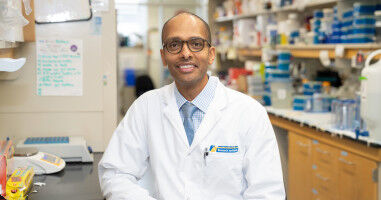
Qingnan Sun, PhD student at the ARTORG Center, with the model which learns while being used by an individual and is able to provide personalized advice on insulin treatment.
The ARTORG Center for Biomedical Engineering Research of the University of Bern is the recipient of a grant from JDRF, the leading global funder for type 1 diabetes research. Thanks to the grant, a team led by Stavroula Mougiakakou will investigate a large, real-world dataset to develop advanced algorithms for automated insulin delivery that are capable of predicting dangerously low or high blood sugar levels. The goal is to optimize and personalize insulin treatment. People with diabetes have a need to control their blood sugar levels to a normal range at all times. Today, scientifically validated automated insulin delivery (AID) systems are available as tools to enhance self-management. These systems empower people with diabetes to more successfully control their condition to prevent hypoglycemic (low-glucose) and hyperglycemic (high-glucose) events. However, these tools still have some shortcomings, because the algorithms used in these systems do not react adequately to variables influencing the blood sugar fluctuations in individuals, such as food intake or physical activity.
TO READ THIS ARTICLE, CREATE YOUR ACCOUNT
And extend your reading, free of charge and with no commitment.
Your Benefits
- Access to all content
- Receive newsmails for news and jobs
- Post ads