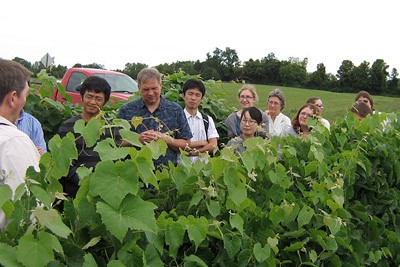
Peter Cousins leads a tour for VitisGen participants.
It can take 20 years of research, resources and effort to bring a new grape variety to market. VitisGen, a multidisciplinary research project co-led by Cornell grape breeder Bruce Reisch, will soon provide breeders tools they can use to develop more and better varieties in that time. The U.S. Department of Agriculture (USDA) has just awarded the project an additional $2.5 million to continue this research. With matching funds from the grape industry, VitisGen's budget now tops $9 million - an unusually large size for specialty crop research. The five-year VitisGen molecular research project, launched in 2011 with an initial $2.1 million grant from the USDA's National Institute of Food and Agriculture Specialty Crop Research Initiative (SCRI), is a collaboration among 25 scientists from 12 institutions, including all of the nation's public grape breeding programs. Their primary goal is to map unique snippets of DNA in the grape genome - called markers - to certain traits, such as cold-hardiness, fruit weight and disease resistance. Once these marker-trait linkages are found across 18 different grape-breeding populations, breeders can use them to streamline hybrid selection and ultimately the release of new grape varieties.
TO READ THIS ARTICLE, CREATE YOUR ACCOUNT
And extend your reading, free of charge and with no commitment.