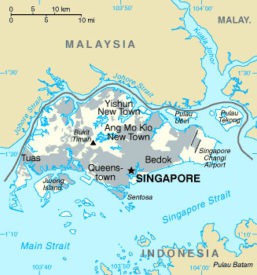
The map above shows Singapore and outline of Singapore and its surrounding islands and waterways.
Slightly raising indoor temperatures and equipping office workers with smart fans saves significantly on overall office building energy costs while maintaining employee comfort, according to new research that could guide the design and operation of new and existing office buildings in the world's tropical regions. In the latest issue of Indoor Air , an interdisciplinary team of researchers from the UC Berkeley, Nanyang Technological University in Singapore and Stanford University lays out the results of experiments conducted in the tropical city-state of Singapore. Some 50 percent of electricity in Singapore is consumed by commercial and residential buildings, mainly to supply air conditioning for occupant comfort and to dehumidify air conditioned spaces. Key findings include: Thermal comfort, perceived air quality and symptoms of sick building syndrome are reported to be equal or better at 26° Celsius and at 29°C, rather than at the common 'set point' of 23°C, if a personally controlled fan is used. The best cognitive performance, as indicated by task speed, was recorded at 26°C; at 29°C, the availability of an occupant-controlled fan partially mitigated the negative effect of the elevated temperature. The typical Singaporean indoor air temperature set point of 23°C yielded the lowest cognitive performance. In the United States, about 75 percent of electricity is used in buildings.
TO READ THIS ARTICLE, CREATE YOUR ACCOUNT
And extend your reading, free of charge and with no commitment.