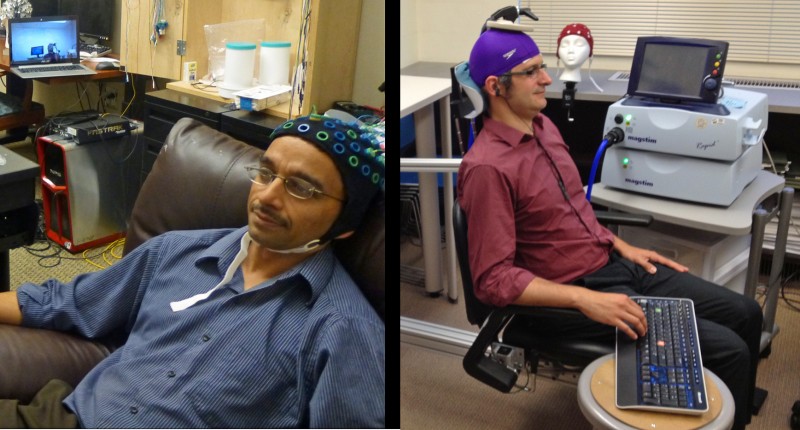
University of Washington University of Washington researcher Rajesh Rao, left, plays a computer game with his mind. Across campus, researcher Andrea Stocco, right, wears a magnetic stimulation coil over the left motor cortex region of his brain. Stocco’s right index finger moved involuntarily to hit the "fire" button as part of the first human brain-to-brain interface demonstration.
University of Washington researchers have performed what they believe is the first noninvasive human-to-human brain interface , with one researcher able to send a brain signal via the Internet to control the hand motions of a fellow researcher. Using electrical brain recordings and a form of magnetic stimulation, Rajesh Rao sent a brain signal to Andrea Stocco on the other side of the UW campus, causing Stocco's finger to move on a keyboard. While researchers at Duke University have demonstrated brain-to-brain communication between two rats, and Harvard researchers have demonstrated it between a human and a rat, Rao and Stocco believe this is the first demonstration of human-to-human brain interfacing. "The Internet was a way to connect computers, and now it can be a way to connect brains,” Stocco said. "We want to take the knowledge of a brain and transmit it directly from brain to brain. The researchers captured the full demonstration on video recorded in both labs. The following version has been edited for length.
TO READ THIS ARTICLE, CREATE YOUR ACCOUNT
And extend your reading, free of charge and with no commitment.