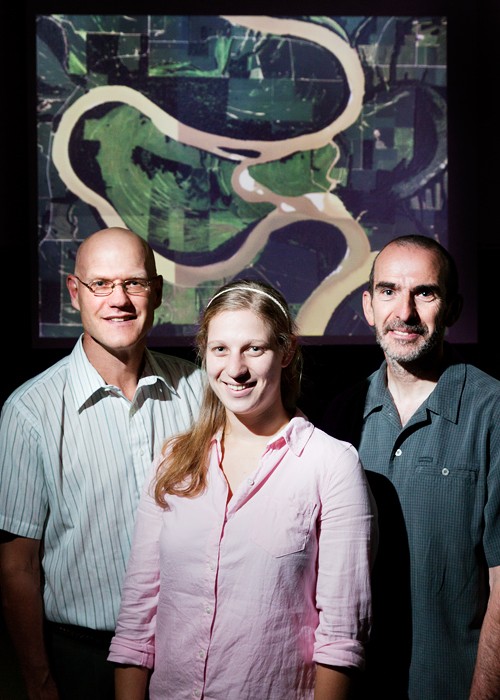
Professors Bruce Rhoads (left) and Jim Best (right) and graduate student Jessica Zinger (center) documented development of two cutoff channels in a bend in the Wabash River, pictured in the background. The cutoffs released huge amounts of sediment into the river.
CHAMPAIGN, Ill. For University of Illinois river researchers, new insight into river cutoffs was a case of being in the right place at the right time. Geography professor Bruce Rhoads and geology professor Jim Best were conducting research where the Wabash River meets the Ohio River in the summer of 2008 when they heard about a new channel that had just formed, cutting off a bend in the winding Wabash just upstream from the confluence. That serendipity gave the researchers a rare view of a dynamic, little-understood river process that changed the local landscape and deposited so much sediment into the river system that it closed the Ohio River. "It was fortunate to be there right when it was beginning to happen, because these are hard-to-predict, unusual events, particularly on large rivers," Rhoads said. While cutoffs are common in meandering rivers, or rivers that wander across their floodplains, the conditions surrounding cutoff events are poorly understood. Most cutoffs are discovered long after they first develop.
TO READ THIS ARTICLE, CREATE YOUR ACCOUNT
And extend your reading, free of charge and with no commitment.