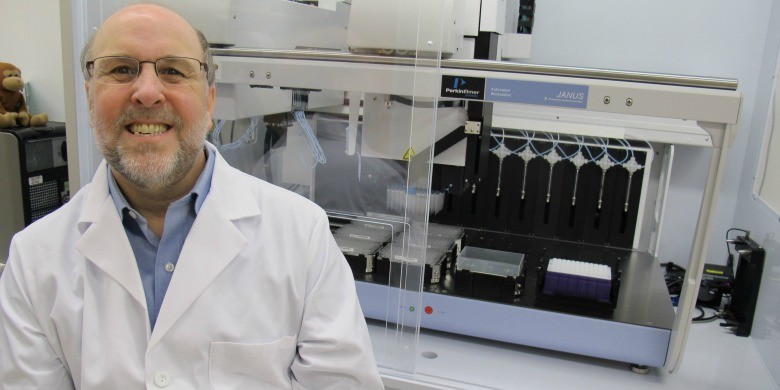
UAlberta medical researcher Michael Weinfeld and his colleagues discovered that knocking out a particular "lethal partner" gene can kill some cancer cells while leaving healthy cells intact.
Medical researchers at the University of Alberta have discovered that knocking out a particular "partner" gene is the Achilles heel of some cancers. Cancer-causing genes often have a partner in crime, meaning when either of the two genes is active in cancer cells, the tumour grows. The challenge for researchers has been pinpointing the genes' "lethal partners." Loss of one of the partners alone isn't deadly to the cell, but if both are removed, the cancer cells are destroyed. Faculty of Medicine & Dentistry researcher Michael Weinfeld and his collaborators, Edan Foley and graduate student Todd Mereniuk, took cells and artificially removed a particular gene known as PKNP. Then the team knocked out 7,000 other genes, one at a time, all in an effort to find PKNP's "lethal partners" that trigger cell death. And the team found it—a deadly partner gene, a rare type of cancer suppressor typically missing in lymphomas. The team confirmed their findings by examining tumours that lacked this specific cancer suppressor.
TO READ THIS ARTICLE, CREATE YOUR ACCOUNT
And extend your reading, free of charge and with no commitment.