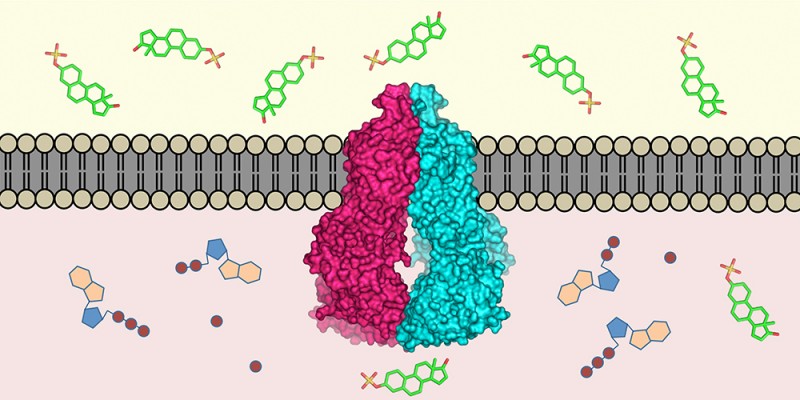
The transport protein ABCG2 (center) is embedded in the cell membrane. It recognises over 200 substances in the cell interior (below) and transports them outside (above). (Image: ETH Zürich / Scott Jackson, Ioannis Manolaridis, Kaspar Locher)
Drug resistance is not only a major problem in fighting infectious diseases. Also in the treatment of cancer it can jeopardize the success of chemotherapy. A reason for this are the so-called transport proteins that 'pump' the drugs out of the cells. Researchers at the Biozentrum of the University of Basel and the ETH Zurich have now been able to elucidate the three dimensional atomic structure of an important drug transporter. The results recently published in 'Nature' provide a basis for counteracting such resistance in the future. In the course of evolution, the human body has developed diverse strategies to protect itself from harmful substances. In the intestine, the placenta and also in the blood-brain barrier are tiny transport proteins, which prevent the absorption of toxins by "pumping" them out of the cells.
TO READ THIS ARTICLE, CREATE YOUR ACCOUNT
And extend your reading, free of charge and with no commitment.