By weakening the North Atlantic overturning circulation, the ocean absorbs less carbon dioxide - resulting in consequential costs and further warming of the climate
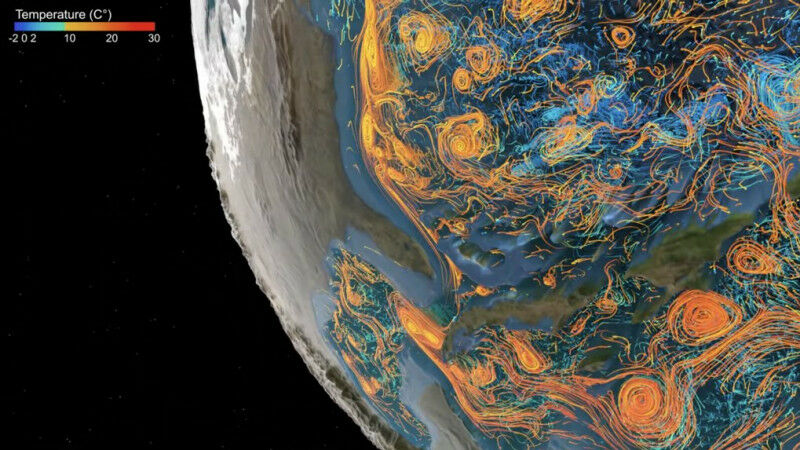
The North Atlantic Overturning Circulation - Amoc for Atlantic Meridional Overturning Circulation - channels warm water from the tropics to the north and lets cold water flow back to the south. In this way, it acts as a radiator for Europe’s climate. The fact that it threatens to lose strength in the course of climate change has so far been seen as beneficial by economic research, as this could cool the northern hemisphere in times of global warming. -However, the Amoc slowdown would further accelerate climate change," explains Felix Schaumann, PhD student in sustainability economics at the University of Hamburg and the Max Planck Institute for Meteorology.
The CO2 content of the atmosphere is rising
It was already known that the melting ice in the Arctic is releasing huge quantities of fresh water into the oceans. The diluted and less salty seawater is less dense and no longer sinks as easily, which is likely to slow down the Amoc. The ocean is also the largest carbon reservoir on earth. It absorbs more carbon than the atmosphere and organisms on land. The cold waters of the Arctic Ocean are particularly absorbent. Schaumann and his colleague Eduardo Alastrué de Asenjo have now been able to demonstrate this: Due to a weaker Amoc, less carbon dioxide (CO2) is also transported from the sea surface to the depths of the ocean. This means that more CO2 remains in the atmosphere and this increases global warming.Climate warming continues
-Our results suggest that previous studies on AMOC mitigation have probably underestimated the consequences," says Schaumann.
From a global perspective, more frequent and more extreme weather events such as heat, drought and flooding would occur as climate change continues to accelerate. This would increase the social costs of CO2. These costs reflect the damage caused by the emission of CO2. This effect could outweigh the positive economic effects of the cooling caused by Amoc mitigation.
The social costs
The results are based on a global climate model combined with a further model specialized in economic consequential costs. This calculates the consequential costs of climate damage based on the expected CO2 content of the atmosphere. The researchers used this to create a scenario that assumes CO2 development without the Amoc effect and another that includes different degrees of mitigation. They were thus able to show that there is a direct correlation between the strength of the Amoc and the amount of carbon that the oceans absorb.In the run-up to the World Climate Conference: an interview with Jochem Marotzke, Director at the Max Planck Institute for Meteorology in Hamburg