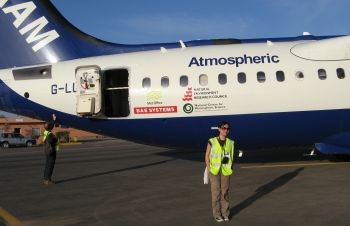
Dr Carolina Cavazos-Guerra from the Geography department by one of two planes used to fly instruments across the Sahara desert to get an idea of the structure of the atmosphere.
University of Sussex geographers have been involved in a short film about an academic project to observe one of the most extreme climates on Earth. The film covers scientific observations of the cloud and dust layers in the central Saharan desert in the summers of 2011 and 2012. During the summer months, a large, low-pressure system caused by intense solar heating develops over a huge, largely uninhabited expanse of northern Mali, southern Algeria and eastern Mauritania. The 17-minute film , Into the Cauldron: A metereological adventure , tells the story of a group of specialists who set up an array of special instruments - both on the ground and in the air - to monitor the winds, temperatures and dust in this empty, fiercely hot and inhospitable region. They also used two aeroplanes to fly instruments across the desert to get an idea of the structure of the atmosphere and how it changes through the day. More than 200 hours of science flights, many at low level (150 feet above the surface) were conducted. The academics are all part of the Fennec project consortium, in which the University of Sussex is a partner with the Met Office and the Universities of Leeds, Oxford and Reading.
TO READ THIS ARTICLE, CREATE YOUR ACCOUNT
And extend your reading, free of charge and with no commitment.