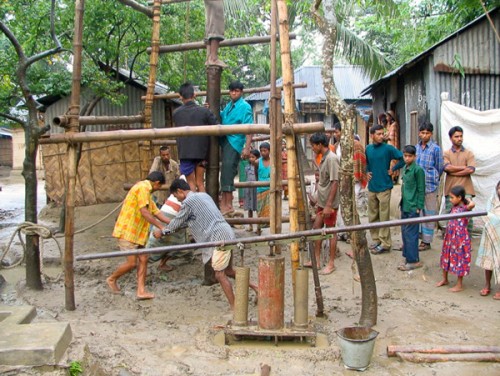
Drilling a deep well in rural Bangladesh to tap into arsenic-free water.
In Bangladesh, people dig deep wells to find drinking water free of naturally occurring arsenic. But farmers are also pumping water from those deep aquifers, threatening the water supply and public health. An estimated 60 million people in Bangladesh are exposed to unsafe levels of naturally occurring arsenic in their drinking water, dramatically raising their risk for cancer and other serious diseases, according to the World Health Organization (WHO). Because most of the contaminated water is near the surface, many people in Bangladesh have installed deep wells to tap into groundwater that's relatively free of arsenic. In recent years, however, farmers have begun using the deep, uncontaminated aquifers for irrigation - a practice that could compromise access to clean drinking water across the country, according to a report in the May 27 issue of the journal Science . The report is co-authored by groundwater experts Scott Fendorf (Stanford University), Holly A. Michael (University of Delaware) and Alexander van Geen (Columbia University). "Every effort should be made to prevent irrigation by pumping from deeper aquifers that are low in arsenic," the authors wrote.
TO READ THIS ARTICLE, CREATE YOUR ACCOUNT
And extend your reading, free of charge and with no commitment.