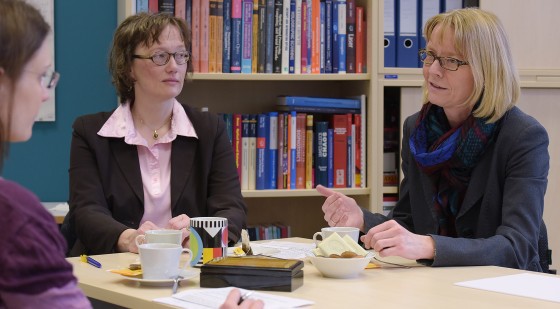
Physicist Cornelia Denz and historian Heike Bungert exchange views on the differences in using foreign languages in Natural Sciences and the Humanities.
- WWU - Peter Grewer
Physicist Prof. Cornelia Denz and historian Prof. Heike Bungert exchange views on the differences in using foreign languages in Natural Sciences and the Humanities. Internationalization permeates Münster University at all levels, from teaching to research. In order to attract even more of the best students from abroad, the University is offering more and more seminars, individual modules, lectures - even entire courses - in English. But is this really necessary? Are German students putting their careers at risk if they opt to use only their native language? Bernadette Winter discussed this with two high-ranking female academics: Prof. Cornelia Denz, Chair of Experimental Physics with a focus on photonics and Vice-Rector for International Affairs and Junior Researchers, and Prof. Heike Bungert, Professor of Modern and Contemporary History with a special focus on North American history. Has your personal attitude to the question "German or English?" changed in the course of your career? - Cornelia Denz: When I began doing research in the 1980s there were only two journals in my subjects, optics and photonics, that were published in German - or in two languages, German and French. They both ceased publication very quickly. I made my career in Germany at a time when the classic academic structures were still very conservative.
TO READ THIS ARTICLE, CREATE YOUR ACCOUNT
And extend your reading, free of charge and with no commitment.