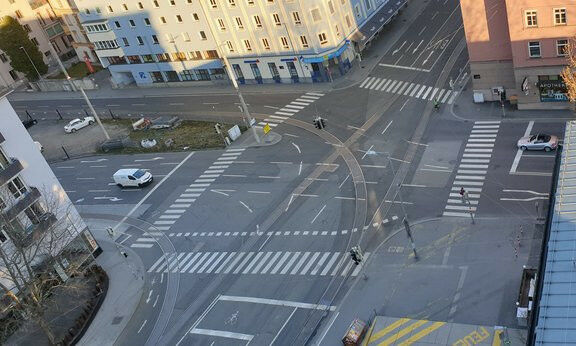
The junction in front of the University of Innsbruck during the coronavirus outbreak. Even after the end of mobility restrictions, carbon dioxide emissions in Innsbruck have fallen sharply.
The junction in front of the University of Innsbruck during the coronavirus outbreak. Even after the end of mobility restrictions, carbon dioxide emissions in Innsbruck have fallen sharply. Air monitoring measurements at the University of Innsbruck's atmospheric observatory show that carbon dioxide emissions in western Austria have fallen by around 20 percent since 2018. Emissions are therefore well below the levels predicted by various models. Observational data is becoming increasingly important for assessing greenhouse gas budgets. Carbon dioxide emissions and trends are often calculated statistically using complex models. "The ability to validate these projections and annual budgets is becoming increasingly important if binding country targets for reducing greenhouse gas emissions are required," says Thomas Karl from the Department of Atmospheric and Cryospheric Sciences at the University of Innsbruck.
TO READ THIS ARTICLE, CREATE YOUR ACCOUNT
And extend your reading, free of charge and with no commitment.