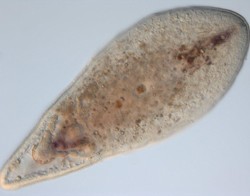
An example of an Acoelomorpha worm, credit: Dr Bernhard Egger, UCL
Two groups of lowly marine worms are related to complex species including vertebrates (such as humans) and starfish, according to new research. Previously thought to be an evolutionary link between simple animals such as jellyfish and the rest of animal life - the worms? surprising promotion implies that they have not always been as simple as they now appear. Although the marine worms Xenoturbella and Acoelomorpha are very simple animals - they lack a developed nervous system or gut - they have been a source of much debate among zoologists. Acoelomorphs were reclassified in the1990?s as an early branch of evolution - the crucial link between the very simplest animals such as sponges and jellyfish and the rest of the animal kingdom including humans, starfish, insects and molluscs. Now an international team lead by scientists from UCL (University College London) and the Université de Montréal have shown that neither type of worm is an early branch of evolution. They show that both groups descended from the same ancestor that gave rise to the complex groups of animals that includes vertebrates and starfish. This implies that the worms have in effect 'evolved backwards' into much simpler looking organisms.
TO READ THIS ARTICLE, CREATE YOUR ACCOUNT
And extend your reading, free of charge and with no commitment.