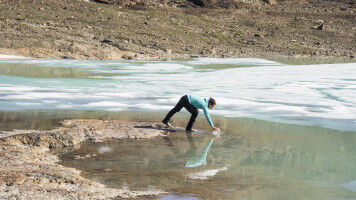
Chris Linder / Univ. of Washington UW graduate student Melinda Webster uses a probe to measure snow depth and verify NASA airborne data. She is walking on sea ice near Barrow, Alaska in March 2012. Her backpack holds electronics that power the probe and record the data.
University of Washington - From research stations drifting on ice floes to high-tech aircraft radar, scientists have been tracking the depth of snow that accumulates on Arctic sea ice for almost a century. Now that people are more concerned than ever about what is happening at the poles, research led by the University of Washington and NASA confirms that snow has thinned significantly in the Arctic, particularly on sea ice in western waters near Alaska. A new study , now online in the Journal of Geophysical Research: Oceans, combines data collected by ice buoys and NASA aircraft with historic data from ice floes staffed by Soviet scientists from the late 1950s through the early 1990s to track changes over decades. Historically, Soviets on drifting sea ice used meter sticks and handwritten logs to record snow depth. Today, researchers on the ground use an automated probe similar to a ski pole to verify the accuracy of airborne measurements. "When you stab it into the ground, the basket move up, and it records the distance between the magnet and the end of the probe,” said first author Melinda Webster , a UW graduate student in oceanography. "You can take a lot of measurements very quickly.
TO READ THIS ARTICLE, CREATE YOUR ACCOUNT
And extend your reading, free of charge and with no commitment.