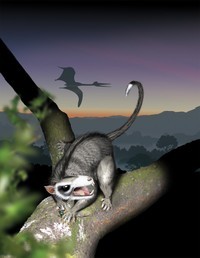
Jude Swales/Burke Museum of Natural History and Culture An artist’s conception depicts a multituberculate in its natural habitat at the time of the dinosaurs.
Conventional wisdom holds that during the Mesozoic Era, mammals were small creatures that held on at life's edges. But at least one mammal group, rodent-like creatures called multituberculates, actually flourished during the last 20 million years of the dinosaurs' reign and survived their extinction 66 million years ago. New research led by a University of Washington paleontologist suggests that the multituberculates did so well in part because they developed numerous tubercles (bumps, or cusps) on their back teeth that allowed them to feed largely on angiosperms, flowering plants that were just becoming commonplace.
- "These mammals were able to radiate in terms of numbers of species, body size and shapes of their teeth, which influenced what they ate,” said Gregory P. Wilson, a UW assistant professor of biology. He is the lead author of a paper documenting -
- Some 170 million years ago, multituberculates were about the size of a mouse. Angiosperms started to appear about 140 million years ago and after that the small mammals' body sizes increased, eventually ranging from mouse-sized to the size of a beaver. Following the dinosaur extinction, multituberculates continued to flourish until other mammals - mostly primates, ungulates and rodents - gained a competitive advantage.
TO READ THIS ARTICLE, CREATE YOUR ACCOUNT
And extend your reading, free of charge and with no commitment.