What if in future wooden parquet floors were not only aesthetically pleasing, but also equipped with sensors - and could even supply their own electricity? Researchers at ETH Zurich and Empa are working on a joint project with parquet manufacturer Bauwerk Group to show what modern and sustainable parquet flooring could be capable of.
Researchers at ETH Zurich and Empa, in collaboration with the Bauwerk Group, have investigated how parquet flooring can not only be manufactured in a more resource-efficient manner in the future, but also generate electrical voltage. The project, funded by Innosuisse, focused on two questions: How can sustainable parquet flooring be produced using types of wood that have been little or not used to date, but will remain available as a resource even in times of climate change? And how can wood be functionalized in such a way that mechanical deformation - for example, when people walk on it - generates enough electrical voltage to serve as a sensor, for example?
Oak is the preferred choice for parquet flooring due to its hardness and appearance, but it is in limited supply. In addition, competition from inexpensive plastic wood imitations is putting increasing pressure on the market. How can these challenges be addressed in a sustainable manner?
The researchers, led by Ingo Burgert, therefore sought alternatives and opted for poplar wood, which has not been used in parquet production to date but could attract more attention in the future as poplars are quite resistant to climate change. Since poplar wood is softer than oak wood, it was modified and compacted using green chemistry using lignin, a by-product of paper production. The result is impressive: a sustainable, resistant parquet with properties comparable to oak.
Parquet as a sensor
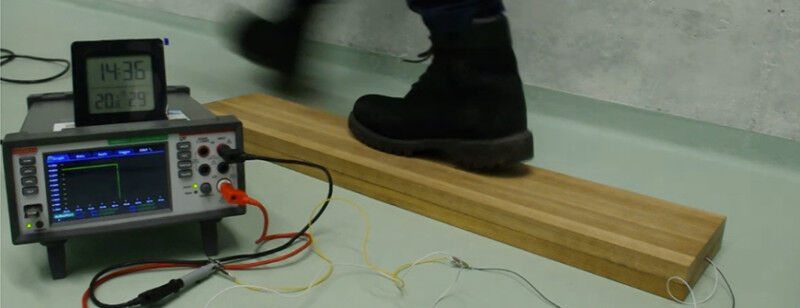
In the second subproject, the researchers investigated how parquet flooring can be modified so that electrical energy is generated by the movement of people. When wood is subjected to mechanical stress, a small electrical voltage is generated by the so-called piezoelectric effect. However, in natural wood, the voltage is too low to be usable. To increase it, Rochelle salt, a by-product of wine production, was embedded in the modified wood structure. Rochelle salt crystals are known for their good piezoelectric properties, but their brittleness limits their use. In combination with wood, a sustainable hybrid structure has been created that is promising and also recyclable. In this combination, the researchers were able to show that the modified parquet can be used as a sensor, as it generates electrical voltage through the movement of people.
Potential applications for piezoelectric parquet flooring can be found in the field of smart homes: Sensors integrated into the floor, for example at doors or under windows, could detect unauthorized entry and automatically trigger an alarm. In the longer term, the researchers are also aiming to produce electricity-generating parquet flooring. Busy locations such as airports and shopping centers are particularly suitable for this. The Tanzhaus Zurich has also already expressed interest. The challenge now lies in upscaling and industrial implementation.
Ingo Burgert emphasizes the importance of industrial cooperation: "Every collaboration expands our understanding of how we can address upscaling even better in the future." He values the direct insight into the production conditions and environment of the partners. "Our aim is to conduct fundamental research that can be implemented and lead to better, and above all more sustainable, products and processes," he summarizes.
With its "piezo parquet," his team was among the five nominees for the HS Timber Group’s Evergreen Prize for Innovation under