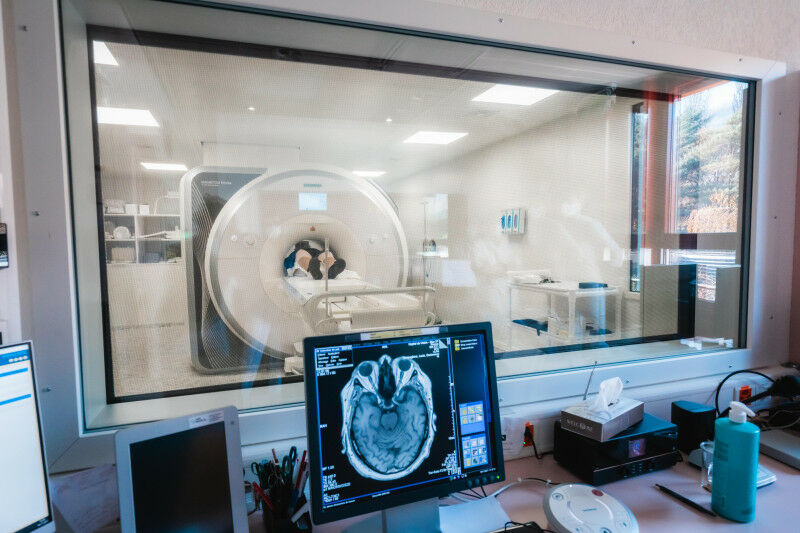
 To study the brain, the Hummel Laboratory at EPFL uses an MRI scanner, which makes it possible to observe the interactions between different neuronal networks.
To study the brain, the Hummel Laboratory at EPFL uses an MRI scanner, which makes it possible to observe the interactions between different neuronal networks. Jamani Caillet, EPFL 2021 Human biology is the research focus of a number of EPFL labs, where scientists conduct clinical trials with volunteers to design therapeutic interventions and to learn more about how the body functions. Here, we take a closer look at the work of Prof. Friedhelm Hummel, who is developing therapies for stroke survivors. François R. sits comfortably in front of a computer monitor, a look of intense concentration on his face. An instruction flashes up on the screen: "Hand to mouth with grasp." He slowly brings his fingers toward his lips. But for the 70-year-old from Valais, this is harder than it sounds: in August 2019, he suffered a stroke that left him paralyzed on his right side from the shoulder down. The electroencephalogram (EEG) cap on his head carries signals from his brain down dozens of wires to a computer, where an algorithm translates sheer willpower into instructions for the robotic glove on his hand.
TO READ THIS ARTICLE, CREATE YOUR ACCOUNT
And extend your reading, free of charge and with no commitment.
Your Benefits
- Access to all content
- Receive newsmails for news and jobs
- Post ads