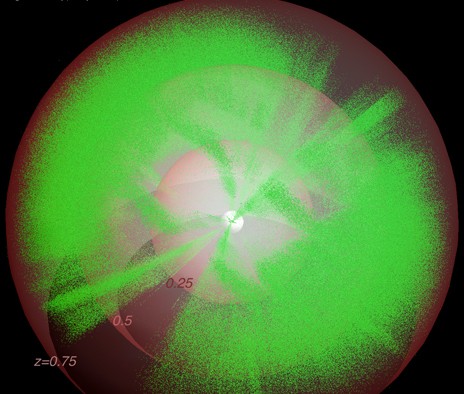
This image shows the positions of the 900,000 luminous galaxies used in these studies. Each green dot represents one galaxy. (Image: David Kirkby, University of California-Irvine, and the SDSS-III Collaboration)
A series of papers released this week by the international scientific collaboration known as the Sloan Digital Sky Survey depended heavily on supercomputing performed by Yale astrophysicists. The four papers - which shed new light on galaxy clustering, and the expansion, structure, and composition of the universe - involved the examination of nearly one million distant luminous, or bright, galaxies. Nikhil Padmanabhan, an assistant professor of physics at Yale, and Antonio J. Cuesta, a postdoctoral student in his lab, used the BulldogM supercomputer in the Yale High Performance Computing Group to compare theoretical and observed patterns of galaxy clustering. This work helped narrow the number of theoretical models likely to describe clustering, and contributed to findings in all four papers in the series. The results were presented Jan. 11 at the American Astronomical Society's winter meeting in Austin. "These studies allow us to look back six billion years, close to a time when the universe was only half as old as it is now," Cuesta said of the research results, which have been published on the arXiv preprint server and submitted to Astrophysical Journal.
TO READ THIS ARTICLE, CREATE YOUR ACCOUNT
And extend your reading, free of charge and with no commitment.