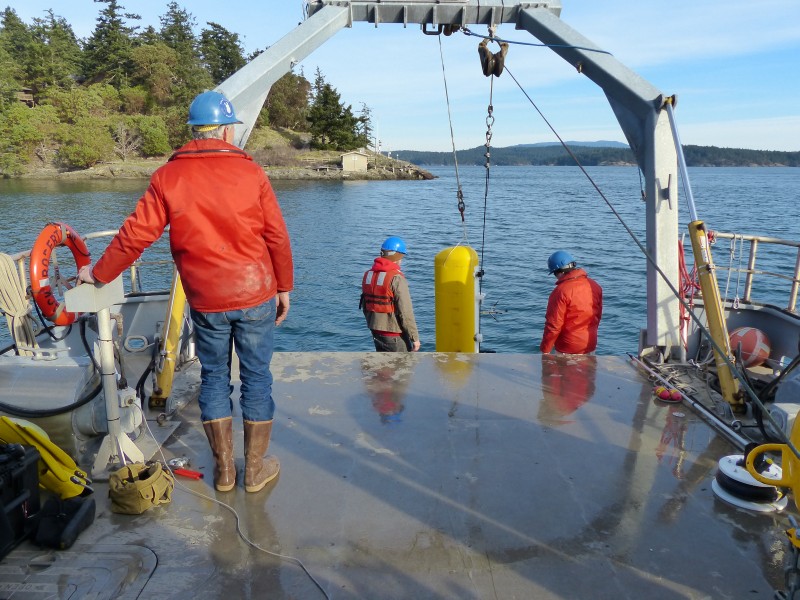
Tim McGinnis, APL Researchers testing the deep profiler last fall at UW’s Friday Harbor Labs. An electric and Internet cable leaves from the gray pump house in the distance - where the lab fills its saltwater tanks - and follows the seafloor to the test site.
University of Washington - The University of Washington this fall will complete installation of a massive digital ocean observatory. Dozens of instruments will connect to power and Internet cables on the seafloor, but the observatory also includes a new generation of ocean explorers: robots that will zoom up and down through almost two miles of ocean to monitor the water conditions and marine life above. Tests are underway for two types of tethered robot , one working at shallow depths and one in the dark depths, that will gather continuous, real-time data about the ocean environment. The robots are part of the UW-led cabled observatory , funded by a $239 million grant from the National Science Foundation and part of the national Ocean Observatories Initiative. The tethered robots will be able to collect long-term observations and respond to events such as large storms or microbial blooms associated with underwater volcanic eruptions. "By having this infrastructure positioned vertically throughout the water column, we will have an unprecedented capability to respond to oceanic events as necessary and to fine-tune our short-term and long-term observational strategies, all without going out there with a ship,” said project scientist Orest Kawka. The robots are now being tested at the UW campus in a saltwater tank and in a tank that can generate up to 10,000 pounds per square inch of pressure.
TO READ THIS ARTICLE, CREATE YOUR ACCOUNT
And extend your reading, free of charge and with no commitment.