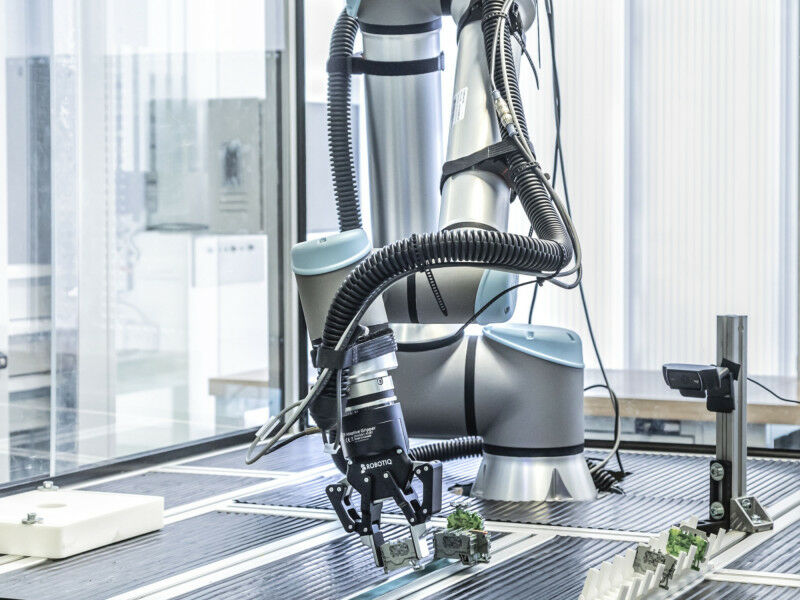
When it comes to assembly tasks, especially regarding small and medium lot sizes, up till now flexible robot programming has been a time-consuming and costly job. The ’Rob-aKademI’ research project, which was launched on July 1, 2020, aims to change this. The technologies used in the project, above all advanced simulation and machine learning, are intended to make programming easier and more autonomous. [Picture: Fraunhofer IPA/Rainer Bez]
When it comes to assembly tasks, especially regarding small and medium lot sizes, up till now flexible robot programming has been a time-consuming and costly job. The 'Rob-aKademI' research project, which was launched on July 1, 2020, aims to change this. The technologies used in the project, above all advanced simulation and machine learning, are intended to make programming easier and more autonomous. Picture: Fraunhofer IPA/Rainer Bez] The partners in the "Rob-aKademI" research project, including Fraunhofer IPA and the Institute for Industrial Manufacturing and Factory Operation IFF at the University of Stuttgart, are developing technologies to simplify robot programming and make assembly tasks easier to automate. The basis for this is a purely digital image - in other words a digital twin - of the manufacturing environment. Combined with a special programming framework, this twin is used in a physical simulation environment to teach robot skills for flexible assembly processes. In the simulation environment, the robot autonomously explores its environment and plans its behavior, optimizing it independently or learning continuously.
TO READ THIS ARTICLE, CREATE YOUR ACCOUNT
And extend your reading, free of charge and with no commitment.