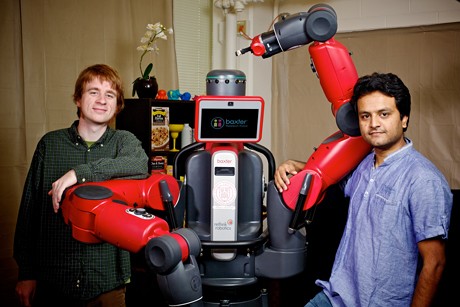
Provided
With multiple joints, a Baxter robot can move more flexibly than a human, but it would be hard for a human to decide how best to use those arms, so the robot is programmed to plan its own movements, then allow humans to make corrections. As a first step, the robot computes three possible trajectories for moving an object and displays them on a touch screen. After an operator selects one, the root goes through the motions and the operator can make refinements. Cornell engineers are helping humans and robots work together to find the best way to do a job, an approach called "coactive learning." "We give the robot a lot of flexibility in learning," said Ashutosh Saxena, assistant professor of computer science. "We build on our previous work in teaching robots to plan their actions, then the user can give corrective feedback." Saxena's research team will report their work at the Neural Information Processing Systems conference in Lake Tahoe, Calif. Dec. Modern industrial robots, like those on automobile assembly lines, have no brains, just memory.
TO READ THIS ARTICLE, CREATE YOUR ACCOUNT
And extend your reading, free of charge and with no commitment.