The Principality of Saxe-Jena existed for just 18 years before the last male scion, Johann Wilhelm, died in 1690 at the age of 15 and the house disappeared from History. Two years earlier, the young nobleman had begun studying at the University of Jena at the age of 13 and, as sovereign, had also assumed the office of princely rector.
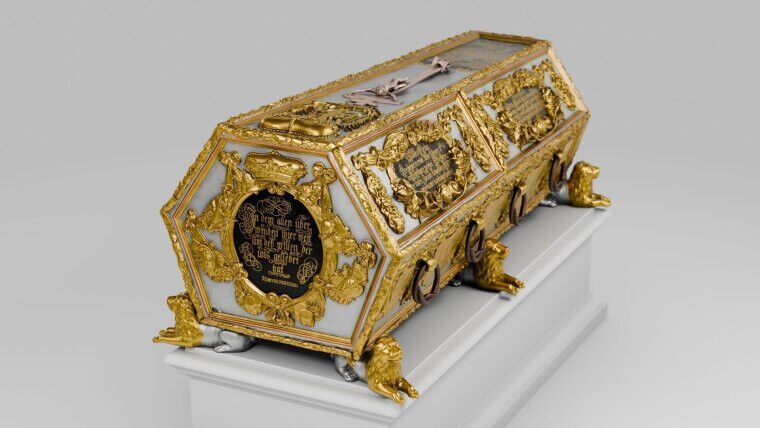
Today, the Prince’s crypt in Jena’s St Michael’s Church bears witness to his extremely short reign. The princely family is buried there in four pewter coffins. The coffin of the last heir stands out in particular: it is one of the most beautiful baroque coffins in central Germany. In order to bring this splendour back to life in all’its glory, the Friedrich Schiller University Jena has now worked with restoration and digitisation experts-supported by the Ernst Abbe Foundation-to create a colour reconstruction of the pewter coffin that has never been seen before in Europe.
As part of Digitisation experts from the Weimar-based company Digitus Art captured the elaborately designed coffin in 3D and created a three-dimensional image on the computer.
»At the same time, the restoration team led by Prof. Bernhard Mai used X-ray fluorescence analysis to investigate the surfaces of the coffin and initially deduced the metal composition and thus also the colouring of the respective areas, which has disappeared over the centuries. Over time, the tin surfaces have darkened and the gilding has rubbed off. In addition, some decorative elements are missing«, explains Dr Enrico Paust, curator of the Prehistory and Early History Collection at the University of Jena, who led the reconstruction project. »Based on this information, we were able to create a colour reconstruction of the coffin on the computer and restore its original splendid appearance.«
Alphabet recreated in original font
Thanks to the reconstruction, it can now be shown, for example, that the crucifix on the lid had a reddish shimmer, as it was made from an alloy of silver and copper-so-called rosé silver. The experts also added the inscriptions on the top of the coffin lid, which are barely recognisable on the original. To do this, they created an alphabet by hand based on the inscriptions on the side walls, which are better preserved, and joined the letters together to form the text that was already known from a copy. »In over 100 hours of labour, the reconstruction of a Baroque ceremonial coffin was created, which sets new standards throughout Europe«, says Enrico Paust. The three-dimensional replica is available on the Internet, supplemented by further valuable information about the coffin and its lively History.
Message in a bottle in the coffin
»Shortly after the Second World War, thieves stole some gold-plated pewter decorative discs and left a hole in the coffin, through which an arson attack was carried out on the tomb in 1958«, reports the Jena archaeologist. »The attackers poured burning phosphorus into the coffin, which severely damaged the wooden inner coffin and also left damage to the pewter coffin.« Experts from the fields of prehistory, early history and anthropology were then called in to open the coffin and extinguish the smouldering fire. They then removed part of the inner coffin and the bones for scientific examination and closed the coffin again.
Almost 70 years later, as part of the restoration project, the scientists from Jena used an endoscope to take another look inside the coffin and discovered that the bones removed in the 1950s had not been put back. Instead, the former colleagues had left a message in a bottle in which they communicated their findings and the location of the bones in the osteological collection. They also captured a three-dimensional image of what the researchers saw when they opened the coffin and made it available online.
»All digitisation work before, during and after the restoration is primarily of a documentary nature. On the one hand, we have used the images to record the respective condition and, on the other, we will be able to track how the condition of the materials changes in the future«, explains Enrico Paust. The Jena researchers also analysed the contents of the coffin in detail. For example, they scrutinised textile remains to find out more about the burial traditions of the time. All of the coffin’s contents have now been reinterred in the original coffin-and in a new inner coffin made of zinc.