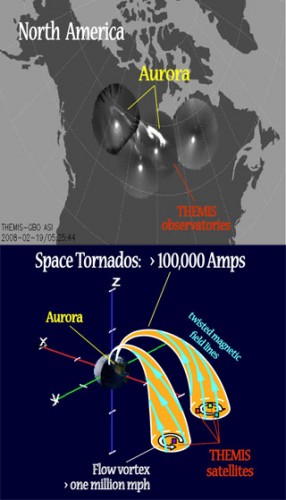
Space tornadoes span a volume of space about the size of the Earth, and funnel hot ionized gas into the ionosphere, triggering bright auroras.
Vienna, Austria - Earth-bound tornadoes are puny compared to "space tornadoes," which span a volume as large as Earth and produce electrical currents exceeding 100,000 amperes, according to new observations by a suite of five NASA space probes. The probe cluster, called Time History of Events and Macroscale Interactions during Substorms (THEMIS), recorded the extent and power of these electrical funnels as the probes passed through them during their orbit of Earth. Ground measurements showed that the space tornadoes channel the electrical current into the ionosphere to spark bright and colorful auroras on Earth. Space tornadoes are rotating plasmas of hot, ionized gas flowing at speeds of more than a million miles per hour, far faster than the 200 m.p.h. winds of terrestrial tornadoes, according to Andreas Keiling, a research space physicist at the University of California, Berkeley's Space Sciences Laboratory. Keiling works on THEMIS, which was built and is now operated by UC Berkeley. The five space probes were launched by NASA in February 2007 to solve a decades-long mystery about the origin of magnetic storms that power the Northern and Southern Lights Both terrestrial and space tornadoes consist of funnel-shaped structures.
TO READ THIS ARTICLE, CREATE YOUR ACCOUNT
And extend your reading, free of charge and with no commitment.