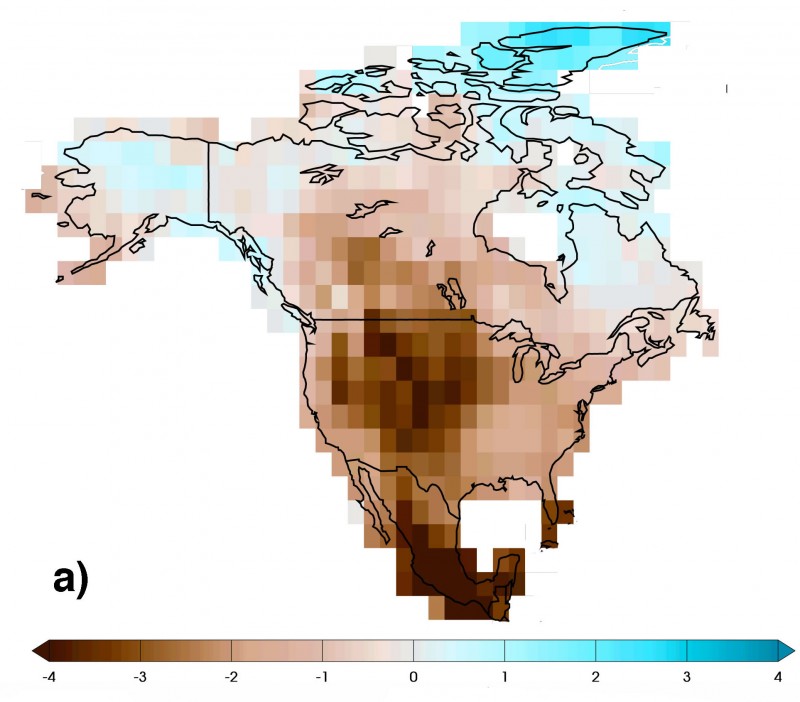
This image represents the multi-model projection of the Palmer Drought Severity Index (PDSI) averaged over the period of 2089-2098. A PDSI less than -2 indicates "moderate drought". PDSI less than -3 indicates "severe drought.
While the worst drought since the Dust Bowl of the 1930s grips Oklahoma and Texas, scientists are warning that what we consider severe drought conditions in North America today may be normal for the continent by the mid-21st century, due to a warming planet. A team of scientists from the Lawrence Berkeley National Laboratory (Berkeley Lab), Lawrence Livermore National Laboratory (LLNL), and the National Oceanic and Atmospheric Administration (NOAA) came to this conclusion after analyzing 19 different state-of-the-art climate models. Looking at the balance between precipitation and evapotranspiration-the movement of water from soil to air-they found that no matter how rainfall patterns change over the next 100 years, a warming planet leads to drought. Their "Drought is a relative condition and in general is characterized by a lack of available water. There are many indices for evaluating drought because different people require information about water availability in different ways," says Michael Wehner, a climate scientist in the Berkeley Lab's Computational Research Division and lead author of the paper. "Our results focus on a drought measure that is relevant to soil moisture and is of concern to agricultural and forestry interests. The models project widespread future drought conditions in the United States as the global climate warms over the course of this century." To determine today's normal drought conditions, Wehner and his teammates looked at the average balance between rainfall and evapotranspiration for North America based on observational data collected by NOAA's National Climatic Data Center for the period between 1950 and 1999.
TO READ THIS ARTICLE, CREATE YOUR ACCOUNT
And extend your reading, free of charge and with no commitment.