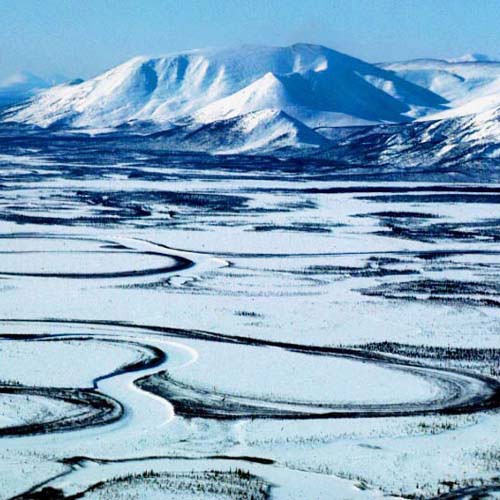
While the atmospheric source of mercury in the Arctic was previously recognized, it now appears that twice as much mercury actually comes from the rivers. (Photo courtesy of the U.S. Fish & Wildlife Service.)
Harvard study finds circumpolar rivers most responsible for high levels of mercury in the Arctic. The Lena River delta. The Lena is one of several major rivers that flows northward into the Arctic Ocean. (False-color satellite image courtesy of NASA. Environmental scientists at Harvard have discovered that the Arctic accumulation of mercury, a toxic element, is caused by both atmospheric forces and the flow of circumpolar rivers that carry the element north into the Arctic Ocean. While the atmospheric source was previously recognized, it now appears that twice as much mercury actually comes from the rivers. The revelation implies that concentrations of the toxin may further increase as climate change continues to modify the region's hydrological cycle and release mercury from warming Arctic soils.
TO READ THIS ARTICLE, CREATE YOUR ACCOUNT
And extend your reading, free of charge and with no commitment.