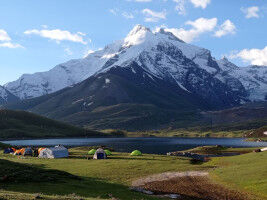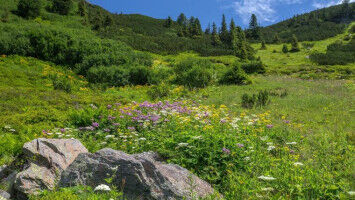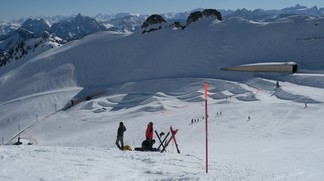
In the context of a landscape genetics research project dedicated to the study of adaptation of an Alpine plant species to its environment, a team of LASIG's scientists were last Friday on the top of les Rochers-de-Naye. The ultimate goal of the project is to track genes underlying adaptive response to solar radiation in the Buckler Mustard (Biscutella laevigata). Accompanied by partners Christian Parisod ( Laboratory of Evolutionary Botany , University of Neuchâtel ) and François Gervaix ( Laboratory G2C , University of Applied Science Western Switzerland ), the goal was to acquire solar radiation data on the snowy landscape using a flying robot equipped with a high-resolution camera. After two previous missions in July and October , this was the third flight in les Rochers-de-Naye with the R-POD team. In addition to solar radiation data, the images acquired will permit to generate a very high resolution digital elevation model (25cm) and related derivatives (slope, aspect, curvature, temperature, protection indices, etc. These environmental variables are then used to assess their level of association with the frequency of molecular markers, and thus identify genomic regions possibly under natural selection. Previous works have documented lineages of the Buckler Mustard that are locally adapted to differential radiation regimes and that are forming a natural hybrid zone in les Rochers-de-Naye.
TO READ THIS ARTICLE, CREATE YOUR ACCOUNT
And extend your reading, free of charge and with no commitment.
Your Benefits
- Access to all content
- Receive newsmails for news and jobs
- Post ads