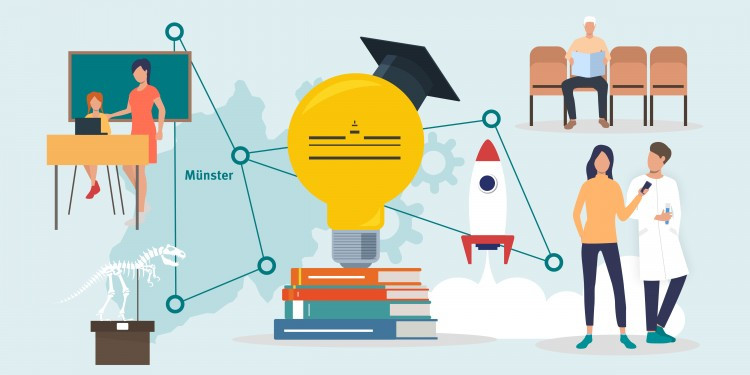
 Not a one-way street: Knowledge transfer at the University of Münster takes place in exchange with society - be it through museum exhibitions of collections, special offers for children and senior citizens, support for founders or the preparation of research results in a way that can be understood by the general public.
Not a one-way street: Knowledge transfer at the University of Münster takes place in exchange with society - be it through museum exhibitions of collections, special offers for children and senior citizens, support for founders or the preparation of research results in a way that can be understood by the general public. GUCC grafik & film Annette Barkhaus, a member of the German Council of Science and Humanities on the challenges presented by the transfer of research results in the field of higher education in Germany Knowledge transfer at German universities has been becoming increasingly important for some years now and, more and more, is being recognized as an academic achievement. The transfer of the results of research to society as a whole takes place in a wide variety of different ways, and the process should be seen as a dialogue. Kathrin Nolte spoke to Dr. Annette Barkhaus , deputy head of the Research Department at the German Council of Science and Humanities (Wissenschaftsrat), about the challenges of knowledge transfer for German universities and research institutes. In 2016 the Council of Science and Humanities published a policy paper entitled "Knowledge and Technology Transfer as a Part of Institutional Strategies". What do you understand by the term "transfer"' By "transfer", the Council understands an interactive, multidirectional process. Transfer is not a one-way street from a university or research institute in the direction of society; it also takes place the other way around, into the academic institution.
TO READ THIS ARTICLE, CREATE YOUR ACCOUNT
And extend your reading, free of charge and with no commitment.
Your Benefits
- Access to all content
- Receive newsmails for news and jobs
- Post ads