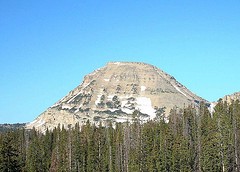
Credit: Nation Parks Service The treeline on Bald Mountain in Utah.
UNIVERSITY PARK, Pa. Some climate cooling caused by past volcanic eruptions may not be evident in tree-ring reconstructions of temperature change, because large enough temperature drops lead to greatly shortened or even absent growing seasons, according to climate researchers who compared tree-ring temperature reconstructions with model simulations of past temperature changes. "We know these tree rings capture most temperature changes quite well," said Michael Mann, professor of meteorology and geosciences and director of the Penn State Earth System Science Center. "But the problem appears to be in their response to the intense short-term cooling that occurs following a very large volcanic eruption. Explosive volcanic eruptions place particulates called aerosols into the stratosphere, reflecting back some fraction of incoming sunlight and cooling the planet for several years following the eruption." Tree rings are used as proxies for climate because trees create unique rings each year that often reflect the weather conditions that influenced the growing season that year. For reconstructing climate conditions, tree-ring researchers seek trees growing at the extremes of their growth range. Inferring temperature changes required going to locations either at the tree line caused by elevation or at the boreal tree line, the northern-most place where the trees will grow.
TO READ THIS ARTICLE, CREATE YOUR ACCOUNT
And extend your reading, free of charge and with no commitment.