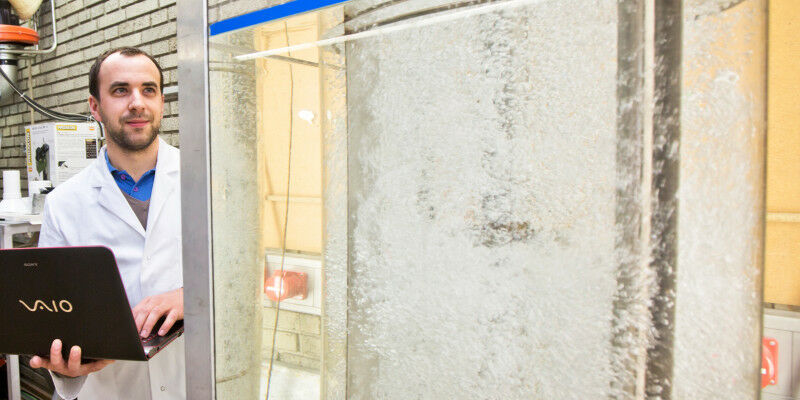
 Christian Witz from the Institute for Process and Particle Technology at TU Graz in front of a Plexiglas model of a stirred and gassed (bio)reactor
By Pelzl New simulation technology developed by TU Graz is designed to make the production of biopharmaceuticals more efficient, cost-effective and comprehensible for manufacturers. Demand for biopharmaceuticals is strong: biopharmaceutical active ingredients - in other words, genetically engineered drugs - accounted for seven of the ten top-selling medications in the world in 2019. And the proportion is set to rise, as biopharmaceuticals can be used to combat conditions such as multiple sclerosis and anaemia, as well as many forms of cancer and rare diseases, which cannot be treated with chemical and synthetic agents. But such efficacy comes at a price. While chemically produced medicines are "small molecules" that are relatively easy to manufacture and are available in tablet form, biopharmaceutical drugs usually comprise hundreds or thousands of atoms. This makes biopharmaceutical manufacturing extremely complex - it requires microorganisms driving reactions in bioreactors, involves expensive experiments carried out on the basis of trial and error, and is based on empirical values. "At the moment, the biotech industry lacks in-depth process knowledge.
TO READ THIS ARTICLE, CREATE YOUR ACCOUNT
And extend your reading, free of charge and with no commitment.
Your Benefits
- Access to all content
- Receive newsmails for news and jobs
- Post ads