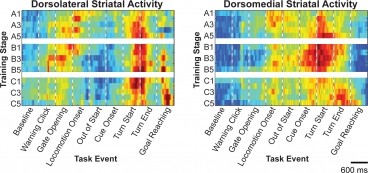
Rats exhibit different patterns of neural activity in the dorsolateral and dorsomedial parts of the striatum while learning to navigate a maze. Dorsolateral striatal neurons are most active (red) when the rat performs specific actions like starting, turning, and stopping. Dorsomedial striatal neurons are most active when the rat is deciding which way to turn, but this activity declines over time as the rat masters the task.
Rats exhibit different patterns of neural activity in the dorsolateral and dorsomedial parts of the striatum while learning to navigate a maze. Dorsolateral striatal neurons are most active (red) when the rat performs specific actions like starting, turning, and stopping. Dorsomedial striatal neurons are most active when the rat is deciding which way to turn, but this activity declines over time as the rat masters the task. Image: Catherine Thorn/MIT CAMBRIDGE, Mass. Driving to and from work is a habit for most commuters ? we do it without really thinking. But before our commutes became routine, we had to learn our way through trial-and-error exploration. A new study out of MIT has found that there are two brain circuits involved with this kind of learning and that the patterns of activity in these circuits evolve as our behaviors become more habitual.
TO READ THIS ARTICLE, CREATE YOUR ACCOUNT
And extend your reading, free of charge and with no commitment.